
FIELD NOTES
In 2007, Ken Levine built a city under the sea and gave the player two minutes to fall in love with it before showing what it cost.
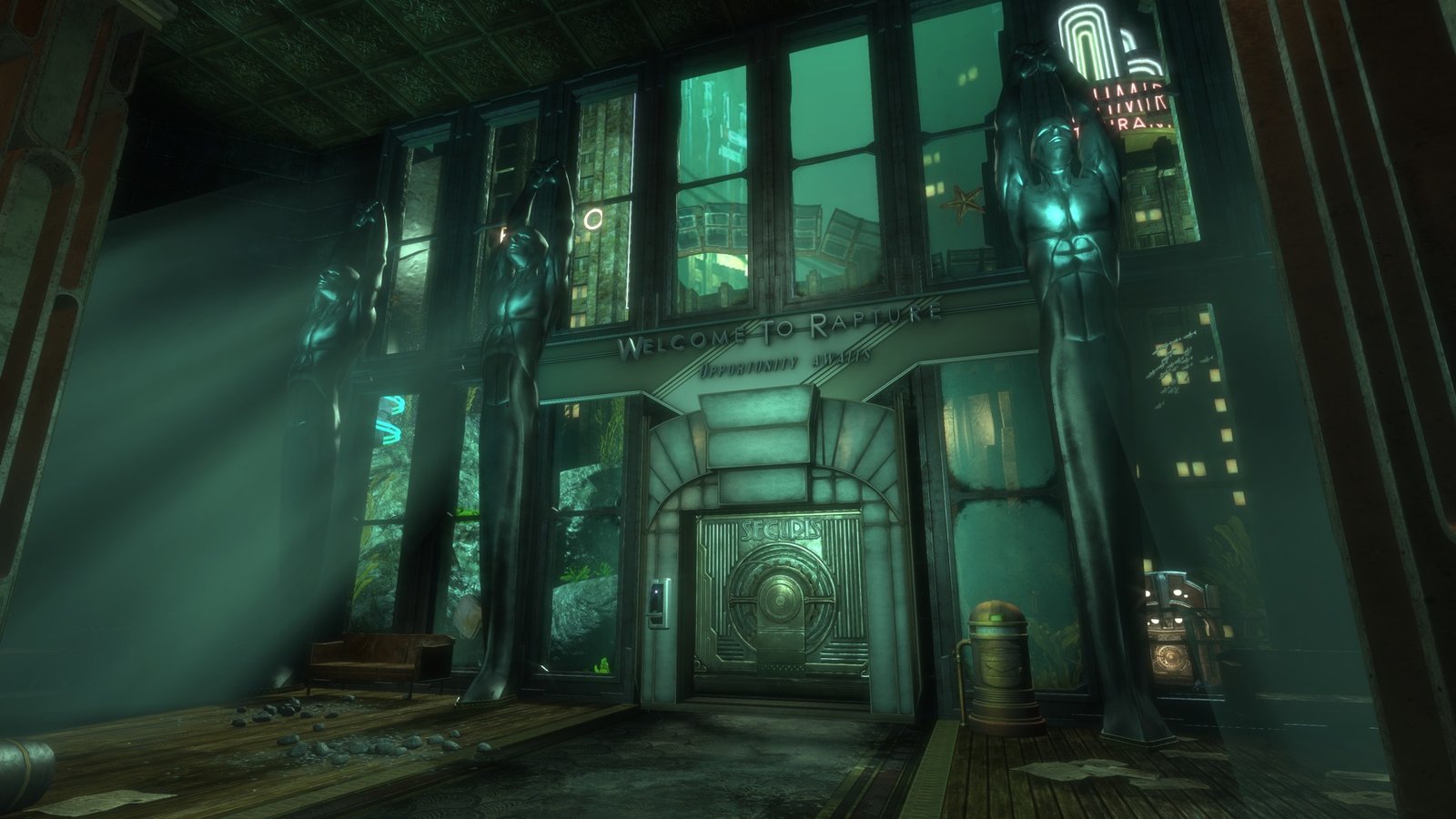
BIOSHOCK, IRRATIONAL GAMES / 2K GAMES, 2007. THE WELCOME CENTER IN RAPTURE: ART DECO GRANDEUR AND RUIN IN THE SAME FRAME. SCREENSHOT FROM BIOSHOCK REMASTERED, 2016.
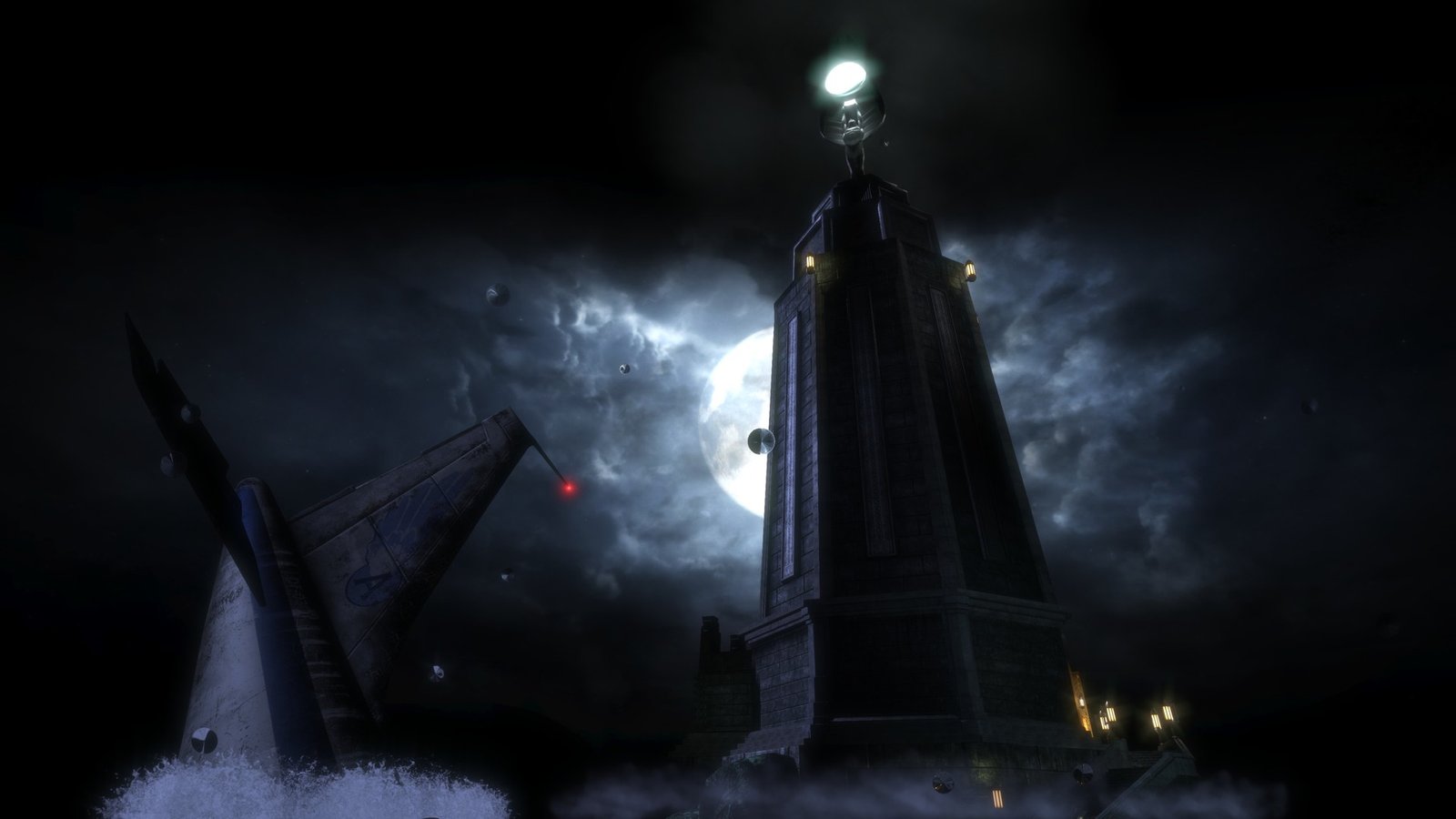
The plane has crashed. The Atlantic is on fire. The player swims to a lighthouse, the only structure visible in the dark water, and finds a bathysphere terminal at the bottom of the stairs. There is no instruction. There is a lever. The player pulls it.
A screen drops across the porthole and a crackling film begins to play. The voice belongs to Andrew Ryan, the city’s founder: “Is a man not entitled to the sweat of his brow?” He rejects Washington, the Vatican, Moscow. He chose something else. The screen lifts. And there it is, through the glass: an entire skyline on the ocean floor, Art Deco towers connected by sealed glass tunnels, neon signs advertising businesses in a city no one on the surface knows exists. A humpback whale passes between two skyscrapers. The scale is immediate. The beauty is not incidental.
Ken Levine, creative director at Irrational Games, later called the descent one of the two moments in BioShock that would always be special to him. Every structure visible through the bathysphere window, he noted, would be a place the player could eventually visit. The city was not a backdrop. It was a floor plan revealed from below.
BIOSHOCK, 2007. THE LIGHTHOUSE IN THE ATLANTIC, THE ONLY SURFACE STRUCTURE MARKING RAPTURE’S LOCATION. THE TAIL OF THE CRASHED PLANE IS VISIBLE AT LEFT. SCREENSHOT FROM BIOSHOCK REMASTERED.
What the player does not yet know is that Art Deco was not chosen because it looked retro-futuristic. Lead animator Shawn Robertson noted that Art Deco’s solid geometric shapes happened to fit within the polygon budget of a 2007 game engine. But that economy of form was a coincidence that served a deeper design intention. Art Deco, historically, was the architectural expression of unregulated ambition: the Chrysler Building, Rockefeller Center, the Empire State Building, monuments to individual wealth constructed in the same decade that produced the Great Depression. In Rapture, the style is not a skin applied over a sci-fi interior. It is the ideology’s physical form.
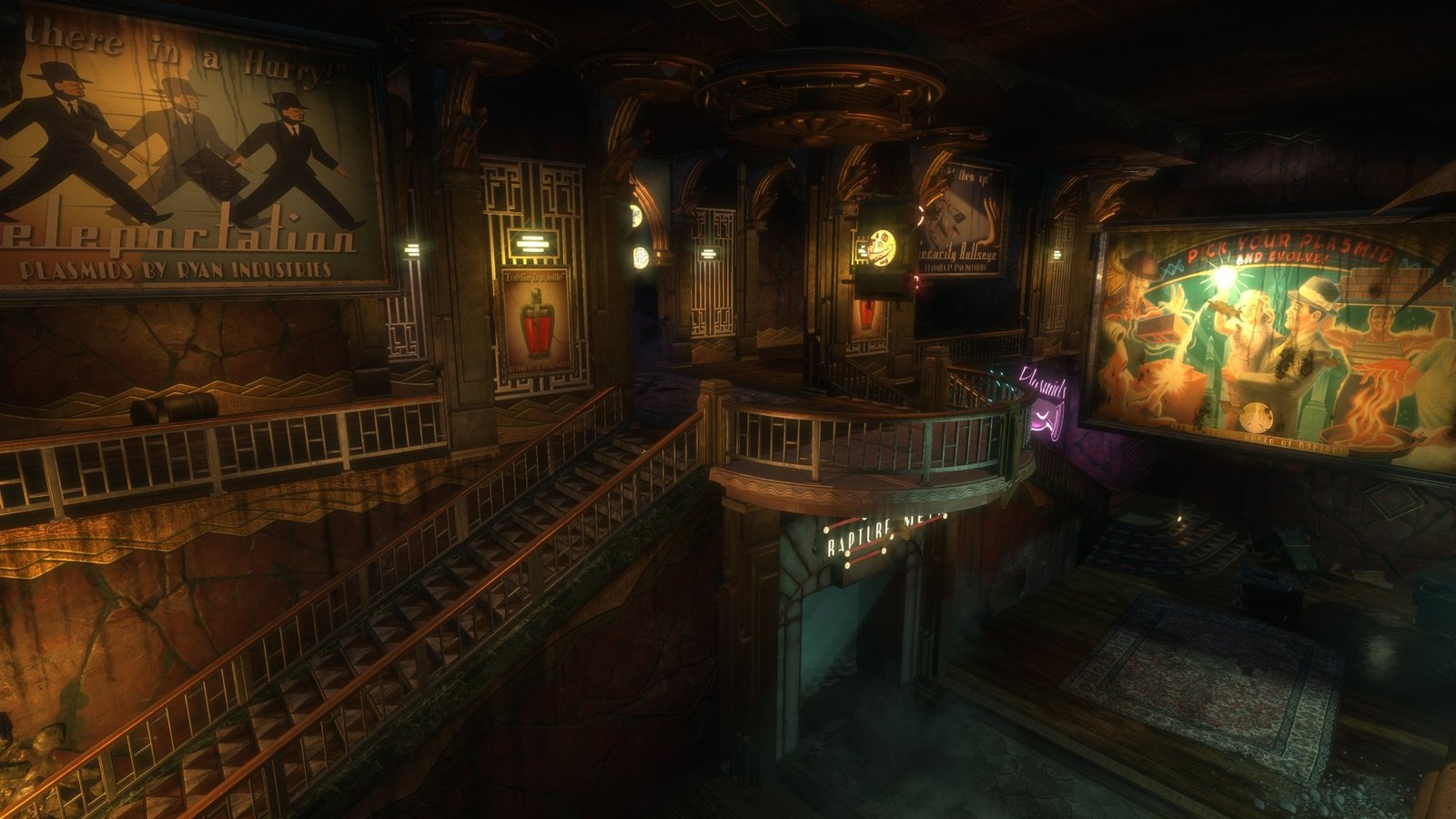
BIOSHOCK, 2007. AN ART DECO COMMERCIAL INTERIOR IN RAPTURE: PERIOD ADVERTISING, BRASS RAILINGS, NEON SIGNS, AND THE RAPTURE METRO ENTRANCE BELOW. SCREENSHOT FROM BIOSHOCK REMASTERED.
Andrew Ryan, whose name rearranges into a near-anagram of Ayn Rand, is an industrialist who fled the surface world to build a society without government, censorship, or regulation. His inspirations are explicit: Rand’s John Galt (the industrialist who disappears into a hidden city in Atlas Shrugged, 1957), with echoes of Howard Hughes and Walt Disney. The city Ryan builds is the architectural conclusion of Objectivist philosophy: a place where the artist answers to no censor and the scientist to no ethics board. Every chevron on the wall and every bronze bust of the founder in the lobbies is a statement of that belief rendered in brass and terrazzo.
The bathysphere docks. The doors open. The city is in ruins.
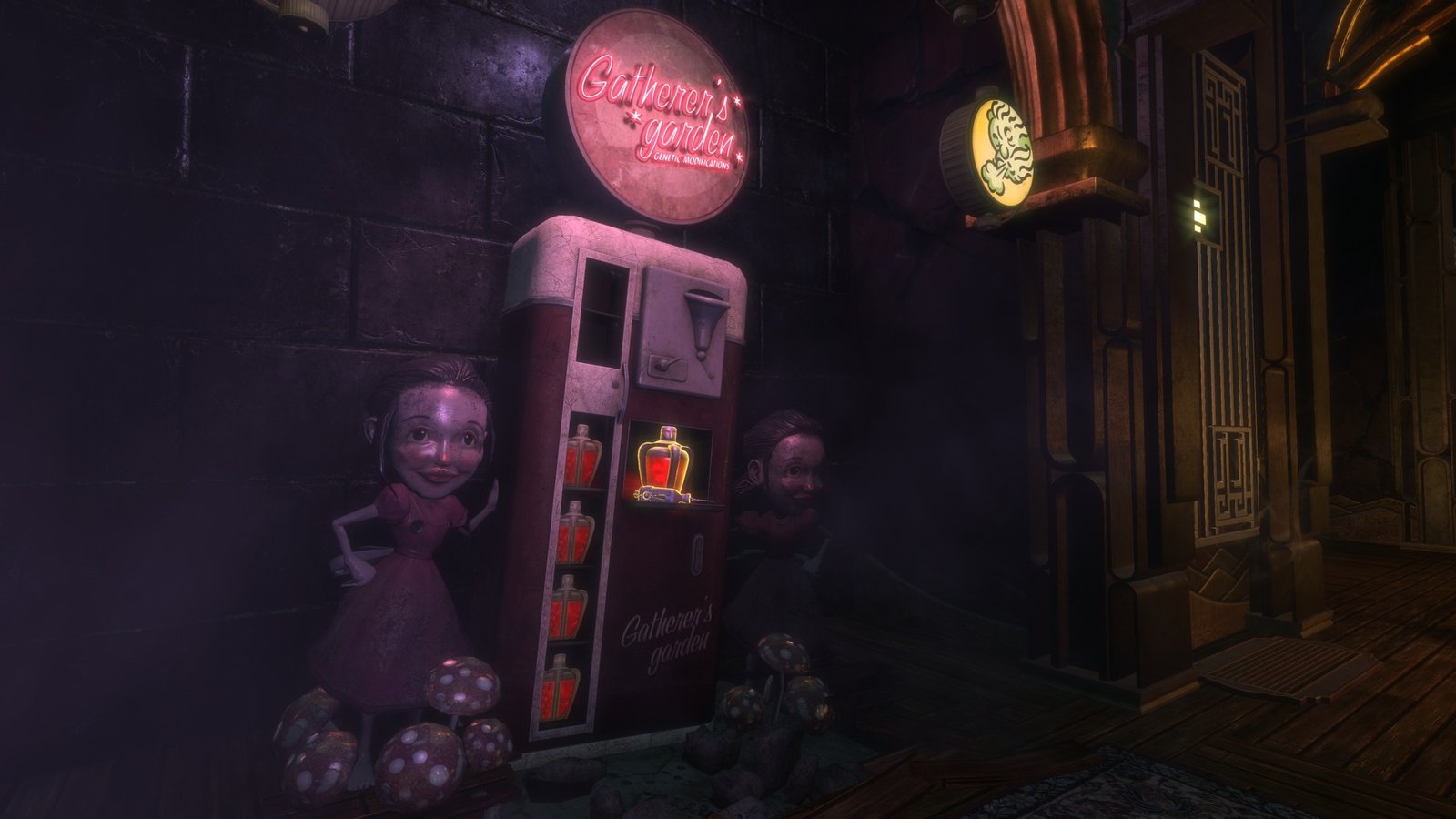
Water seeps through cracked tunnels. Splicers, citizens who modified their own genetics past the point of sanity, crouch in corridors whose proportions remain generous and whose materials remain rich. The neon still glows. The murals are still on the walls. The Rapture Metro signage is still legible. Nothing about the architecture has changed. Only the inhabitants have. This is the core spatial argument of BioShock: the most damaging critique of utopian architecture is not to show it demolished but to show it intact and occupied by people it was never designed to contain.
BIOSHOCK, 2007. A COMMERCIAL CORRIDOR IN RAPTURE: THE NEON STILL GLOWS, THE ART DECO FRETWORK IS INTACT, BUT THE CITY HAS TURNED. SCREENSHOT FROM BIOSHOCK REMASTERED.
The architecture does not degrade into something else. It remains Art Deco. The chevrons are on the walls when the blood is on the floor.
Levine built this argument using a technique borrowed, whether consciously or not, from the tradition of the architectural uncanny: the house that is beautiful but wrong, the corridor that extends where it should not. Anthony Vidler described it in 1992 as the experience of inhabiting a space whose familiarity has been turned against the inhabitant. BioShock translates that concept from critical theory into real-time spatial experience. The player walks through rooms whose ceilings are tall and whose lobby furniture is still arranged for a gathering that ended in violence. The space invites occupancy. Then it punishes it.
What the bathysphere descent teaches is not about games. It is about how architecture carries ideology. Not in the academic sense, where buildings “represent” ideas on a diagram, but in the felt sense: a player enters a space and understands, before a single line of text is read, what this city believed and what that belief cost. Two minutes of descent. A skyline made of conviction. Then the doors open, and the conviction is still there, and the city is gone.
FURTHER READING
BioShock: From Rapture to Columbia. 2K Games, 2015. The official art and design companion to the BioShock series, covering concept art, environment design, and the architectural references behind Rapture and Columbia, with commentary from Ken Levine, Shawn Robertson, and the Irrational Games art team.
Anthony Vidler, The Architectural Uncanny: Essays in the Modern Unhomely. MIT Press, 1992. The critical framework for understanding how familiar spaces become sites of dread, applicable well beyond BioShock to the broader question of why designed environments can betray their inhabitants.
Sources: Irrational Games / 2K Games; BioShock Wiki; PlayStation Blog (Ken Levine interview, 2011); Shacknews (hands-on preview, 2007); CityMonitor; Point’n Think; Game Developer (Gamasutra); DSOGaming.
— The Home&Decor Editors