
SOURCE MATERIAL
In Tokyo and Hong Kong, the smallest homes show how far design can stretch a room, and how much of living small was ever a choice.

HONG KONG ISLAND, SEEN ACROSS VICTORIA HARBOUR.
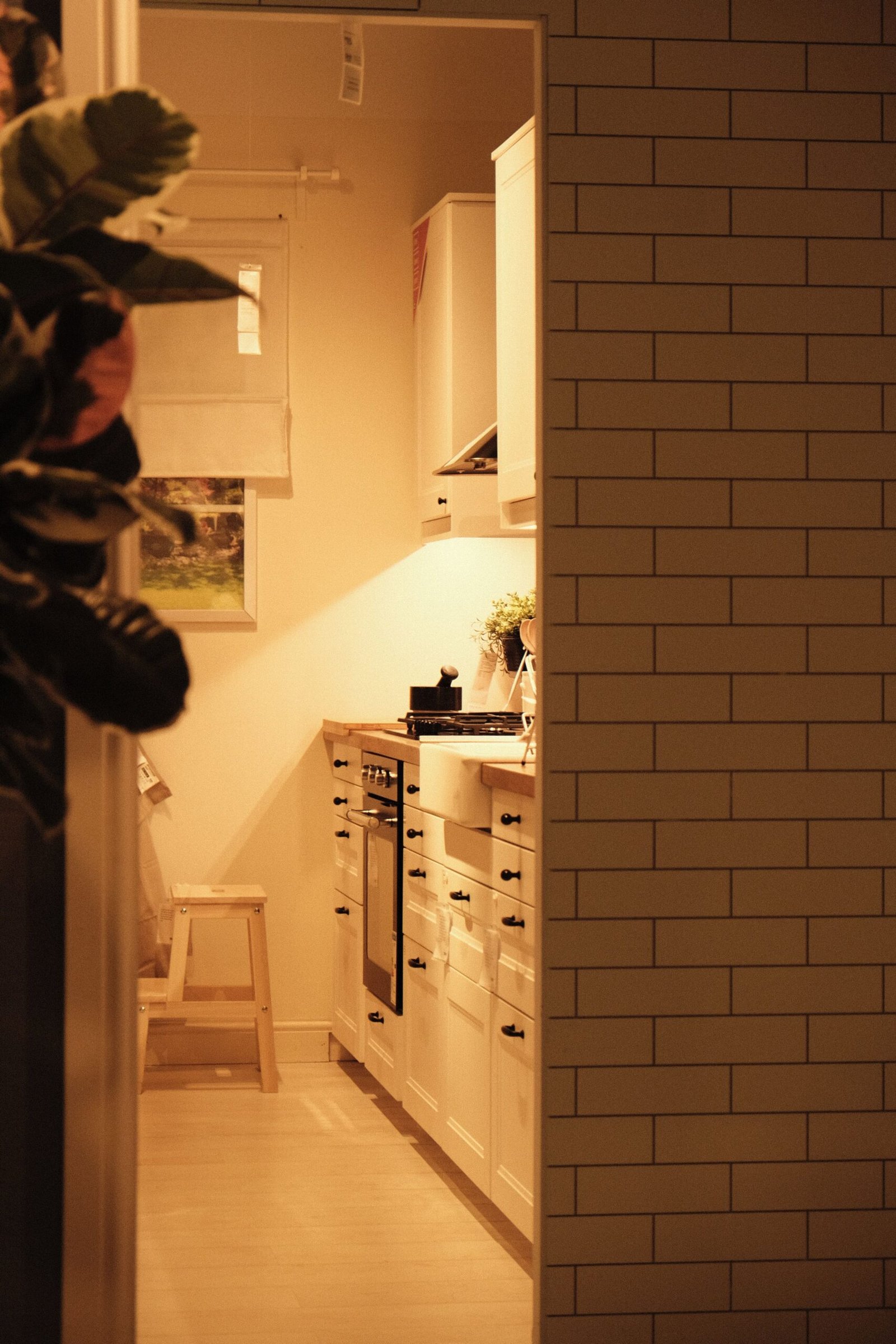
A NARROW KITCHEN, ITS STORAGE CARRIED BY THE WALL.
In some of the world’s densest cities, living small means something specific. In Tokyo and Hong Kong, apartments with very little floor area turn every inch into part of the design. Lofted beds, vertical storage and furniture that does two jobs make these homes work better than their size suggests. They also raise a harder question: how much of living small is actually a choice?
I. LESS SPACE, MORE CITY
In Tokyo, micro-apartments have caught on with young people and those living alone. The floor plans are compact, and the rent is lower than for a conventional apartment, which lets tenants live close to work, to transit and to the city’s busiest neighborhoods.
They also take real ingenuity. The walls carry the storage, a bed sits above a desk, and corners that would go unused in a larger flat hold whatever needs a place. For a generation that spends most of the day between the office, cafés and restaurants, a very small footprint can be enough for the essentials.
II. WHEN LIVING SMALL IS NO LONGER A CHOICE
Living with less can look like an extension of contemporary minimalism. Often it is something else. In cities where housing costs keep rising, giving up space is one of the few ways to stay central, and preference starts to look a lot like necessity.
Hong Kong is perhaps the most extreme case. Beyond small apartments, the city has subdivided units, made by splitting a conventional flat into several separate living spaces. Among them are the so-called “coffin homes” and “cage homes,” spaces so confined that some hold little more than a place to sleep and a few belongings.
Here the conversation moves from ingenuity to whether a space is fit to live in at all. Poor ventilation, little natural light and almost no room turn these units into a visible measure of inequality in one of the world’s most expensive cities.
III. HOW MUCH SPACE DO WE REALLY NEED?
Micro-apartments hold a contradiction at the center of city life. They show that good architecture can make even the smallest space work. They also show that location, independence and access to the city now often cost square footage.
A carefully designed micro-apartment in Tokyo and a subdivided unit in Hong Kong are far apart socially. Both still point to the same question. As cities grow more expensive, the size of a home says less about how we choose to live and more about how much space the city is willing to give us.
Sources: The New York Times; Hong Kong SAR Government; Community Legal Information Centre (Hong Kong); South China Morning Post.
— The Home&Decor Editors