
SOURCE MATERIAL
High-end residential kitchens have started speaking the language of the professional line, the pass and the open steel island. The clearest tell is the second kitchen now hidden behind them.

THE ISLAND AS WORKTOP, TURNED TO FACE THE ROOM. STAINLESS STYLE, A PRIVATE APARTMENT ABOVE THE DUOMO, MILAN. © OFFICINE GULLO.
I. THE LINE COMES HOME
In a private apartment above the Duomo in Milan, Officine Gullo installed a kitchen that reads as a restaurant pulled indoors. A single satin steel worktop runs the length of the island. Set into it: an induction hob, a pasta cooker, a fry-top, and a welded steel sink at one end under a chrome tap. A pyramid hood hangs over the island the way it would over a working line. Facing it, a wall of cabinetry holds two professional refrigerators. The studio is direct about the brief, the owners wanted to cook in their own home the way a chef cooks in a restaurant. Officine Gullo files projects like this under a phrase that says the rest out loud, restaurant at home.

THE COOKING SUITE, PASTA COOKER AND FRY-TOP SET INTO THE WORKTOP. STAINLESS STYLE, MILAN. © OFFICINE GULLO.
The Milan kitchen is the visible edge of a vocabulary that has moved out of the restaurant and into the high-end home over the last few years. The cooking suite sits at the centre of it. Where a residential range once meant Wolf or Viking, the high end now runs up through Molteni and Officine Gullo, where a single suite can cross into six figures. The burners are rated to ten kilowatts, and the pasta cooker is welded straight into the worktop so there is no pan of boiling water to carry. La Cornue sells the same idea in a softer register. These are not appliances scaled for a family dinner. They are appliances scaled for service.
Stainless steel does most of the signalling. In a restaurant it is a hygiene and durability decision; in a home it is a quotation. A satin steel worktop and an exposed range read as professional on sight, which is the point, because the surface announces a level of seriousness before anything is cooked on it. The warmth that domestic kitchens spent decades chasing, the timber and the soft light, is set against cold metal on purpose. The metal is the costume’s first piece.
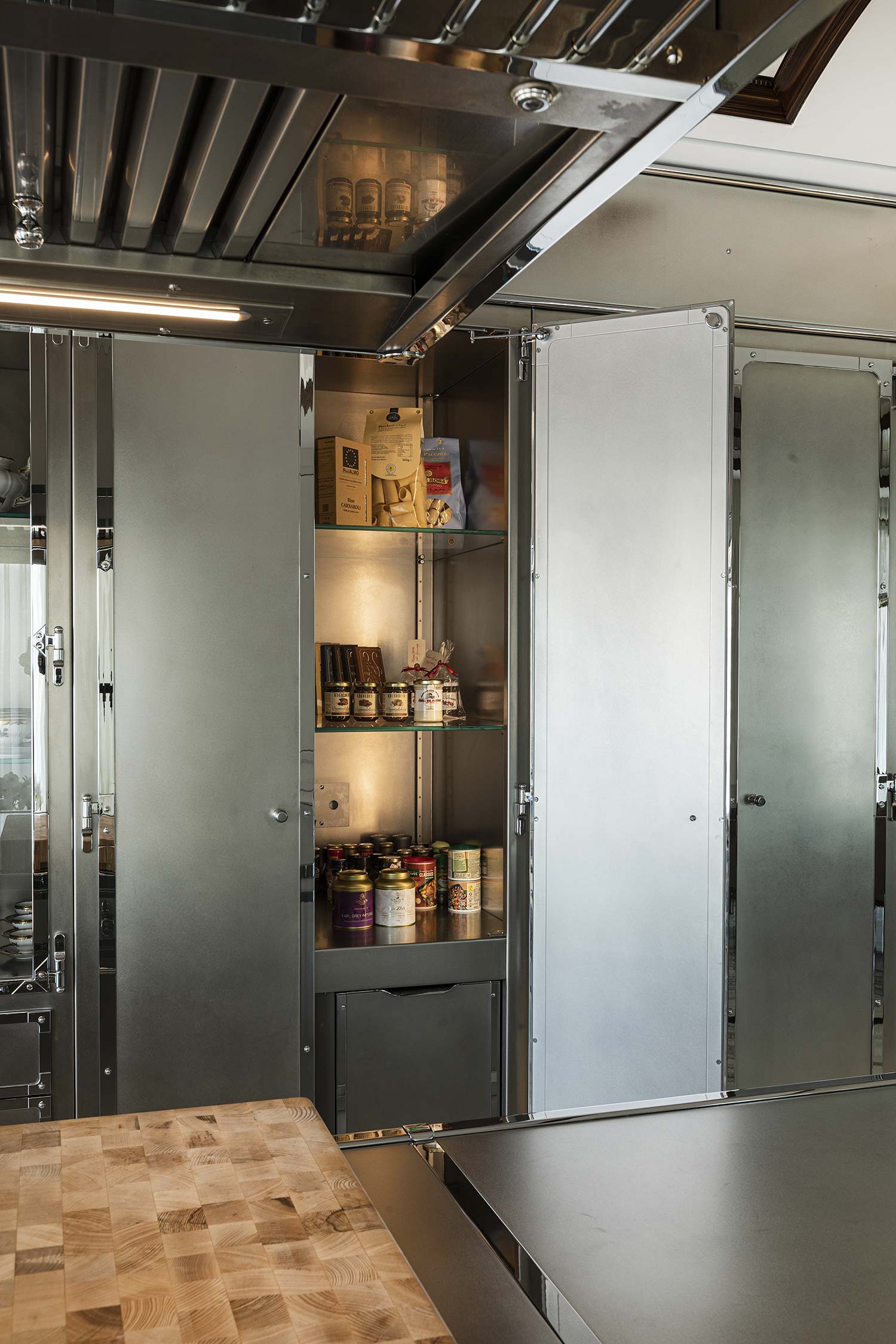
THE PYRAMID HOOD OVER THE ISLAND, SIZED THE WAY A RESTAURANT SIZES IT. STAINLESS STYLE, MILAN. © OFFICINE GULLO.
The refrigeration scaled up to match. Paired full-height columns, commercial-grade boxes from makers such as True Residential, replace the single household fridge, and the island itself stopped being a place to sit. It became a place to work, a continuous run of steel long enough to plate several courses at once, turned deliberately to face the room rather than the wall. This is the restaurant pass rebuilt for the living room. The cook stands behind it, the guests gather in front, and the food crosses the steel between them. Restaurants have understood the value of that sightline for years, where the open kitchen and the visible pass turn service into something to watch, the heat and the plating folded into the meal. The home kitchen has now borrowed the same arrangement, minus the tickets.
The timing is not accidental. When restaurants closed in 2020, the performance that used to happen inside them moved home. Designers began fielding requests for two islands instead of one, a working island and a gathering island, an arrangement one principal called the most valuable kitchen amenity of the period. Espresso machines and wine refrigerators followed, each chosen as much for how it looked in use as for what it did. By the time the restaurants reopened, the kitchen had become the room a house is photographed in, and a professional-grade kitchen had become a line in the luxury property listing, named alongside the square footage.
II. THE STAGE AND THE WINGS

THE SECOND KITCHEN, A LINEAR WORKING LINE BEHIND THE ISLAND. STAINLESS STYLE, MILAN. © OFFICINE GULLO.
The clearest sign that the kitchen has changed jobs is what is now built behind it. Across new luxury construction a second kitchen has reappeared under several names, the scullery, the back kitchen, the dirty kitchen. It holds the second sink and the everyday appliances, and it absorbs the mess the front kitchen is no longer allowed to show. Designers describe it without euphemism as the working kitchen behind the scenes. The demand has been strong enough to move building code; West Palm Beach amended its rules in 2025 to permit a second kitchen inside a single residence, where such kitchens had been restricted for decades.
There is a history folding back on itself here. The scullery was a Victorian room, the place where servants washed and prepped out of sight while the household kept its distance from the labour. Its return inverts the social arrangement but keeps the spatial one. The hidden room is still where the unglamorous work happens. What has changed is who performs out front. The owner now stands at the steel island doing the part of the cooking that looks good, while the chopping and the scrubbing wait in the room next door.

THE WALL FACING THE ISLAND, WITH TWO PROFESSIONAL REFRIGERATORS. STAINLESS STYLE, MILAN. © OFFICINE GULLO.
Read the two rooms together and the logic is plain. If the labour of cooking has been moved to a hidden kitchen, the visible kitchen is no longer where the cooking happens. It is where the cooking is seen to happen. The front kitchen has become a stage, and the scullery is the wings. Restaurants worked this out long ago with the semi-open plan, the theatrical line kept on display and the cleaning kept behind a wall. The luxury home has arrived at the same division, one room for the audience and one for the truth.
The visible kitchen is no longer where the cooking happens. It is where the cooking is seen to happen.
This completes a long migration. The kitchen spent the twentieth century moving out of the back of the house, first into view through the open plan and then into the centre as the room where the household actually gathers. Putting professional equipment into that room is the last step in the sequence. Once the kitchen became the most looked-at room in the house, it was only a matter of time before it was outfitted like a place whose purpose is to be looked at while work is done in it.

SATIN STEEL AND A WELDED SINK, THE SURFACE THAT DOES THE SIGNALLING. STAINLESS STYLE, MILAN. © OFFICINE GULLO.
Seen this way, the professional vocabulary reads less as equipment than as costume. The steel and the restaurant hood give the host the look of a line cook at the top of a service, and the look is the product. What the high-end kitchen now sells is not the capacity to cook more. It is the capacity to be watched cooking.
It is worth noticing what that quietly concedes. The most professional room in the house is the one built to be looked at, and the real cooking has gone back behind a door, where no one is watching.
Sources: Officine Gullo; Yale Appliance; JustLuxe; The Kitchn; Roundhouse Design; House Digest; Eggersmann.
— The Home&Decor Editors