
SOURCE MATERIAL
Marina Tabassum has spent two decades building for a landscape that refuses to hold still. Her two Aga Khan Award projects argue that permanence and portability are not opposites.
BAIT UR ROUF MOSQUE, DHAKA, BANGLADESH. MARINA TABASSUM ARCHITECTS, 2012. PHOTO RAJESH VORA © AGA KHAN TRUST FOR CULTURE.
I. THE OBSERVATION
In 2005, Marina Tabassum’s grandmother, Sufia Khatun, commissioned a mosque. The site was a plot at the northern edge of Dhaka, donated to the community. The budget was modest: $150,000, raised locally. The design took a year. In September 2006, the ground was broken. Four months later, Khatun died. Tabassum became the project’s sole fundraiser, designer, client, and builder.
The problem the site posed was geometric. Its axis created a 13-degree angle with the direction of the qibla. Tabassum inserted a cylinder inside a square. The outer envelope, a 75-by-75-foot brick volume, holds the street edge. The inner cylinder rotates the prayer hall toward Mecca. Between the two shapes, four open-to-sky light courts form, pouring daylight down bare brick walls.
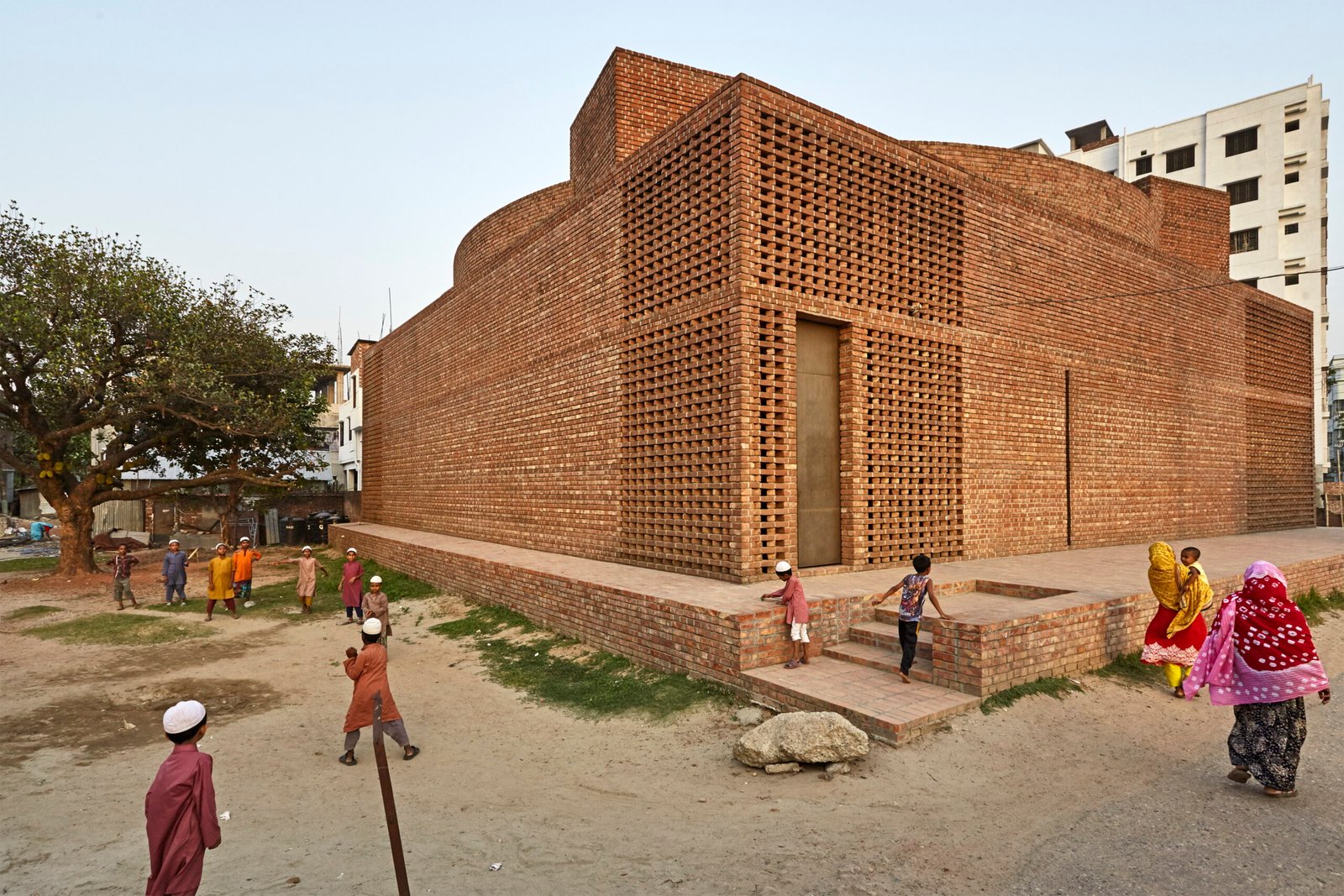
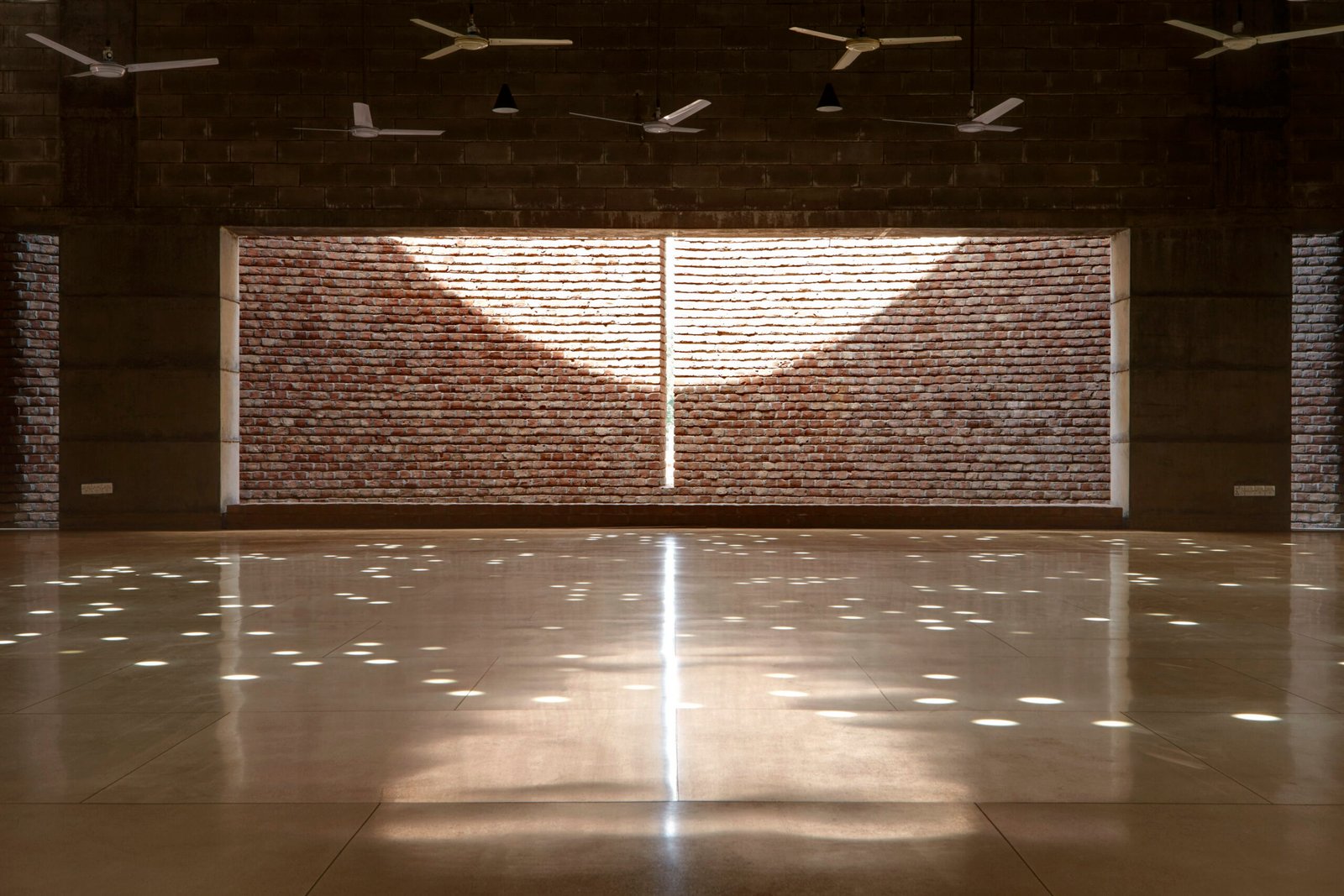
There is no dome. No minaret. No applied ornament. The building is load-bearing brick, left exposed inside and out, with porous bonding patterns that allow monsoon air to cross-ventilate the prayer hall without mechanical systems. The qibla is marked by a slit of light penetrating the curved wall, splayed so that worshippers see sunlight on brick rather than the street beyond.
BAIT UR ROUF MOSQUE, EXTERIOR VIEW. THE RAISED PLINTH SEPARATES THE SACRED FROM THE STREET AND KEEPS FLOODWATER OUT. PHOTO RAJESH VORA © AGA KHAN TRUST FOR CULTURE.
The mosque sits on a raised plinth. In a city where annual floods swallow entire neighborhoods, the plinth is the first architectural gesture: it keeps water out and gives the community a dry platform between the sacred and the street. When the Bait Ur Rouf was completed in 2012, it served eight hundred families. When the Aga Khan Award for Architecture recognized it in 2016, the jury cited its elemental quality: a building made almost entirely of brick and light.
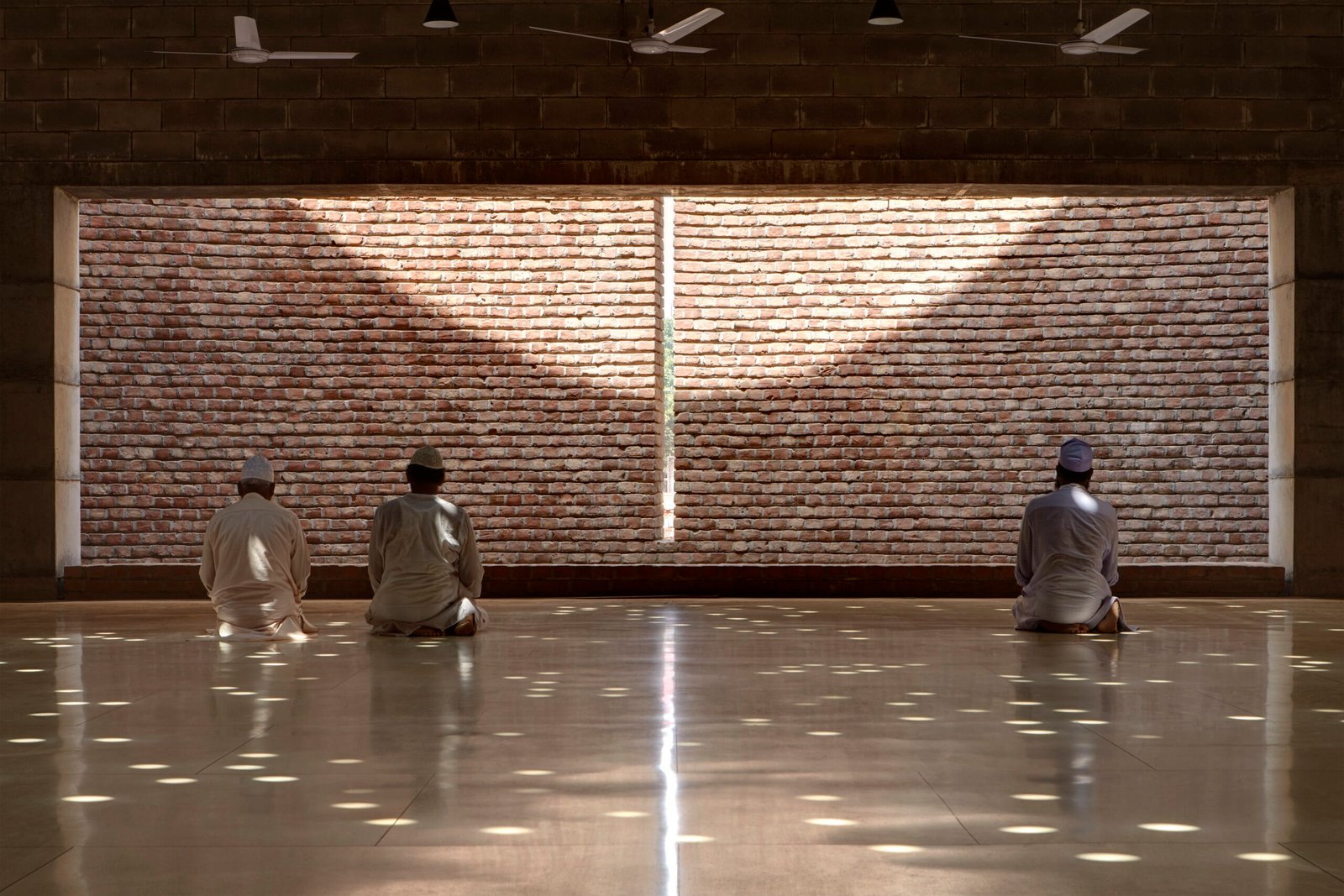
BAIT UR ROUF MOSQUE, PRAYER HALL. A SLIT OF LIGHT MARKS THE QIBLA DIRECTION. CIRCULAR ROOF OPENINGS CAST PATTERNS ACROSS THE POLISHED FLOOR. PHOTO RAJESH VORA © AGA KHAN TRUST FOR CULTURE.
Nine years after the first award, Tabassum won the same prize again.
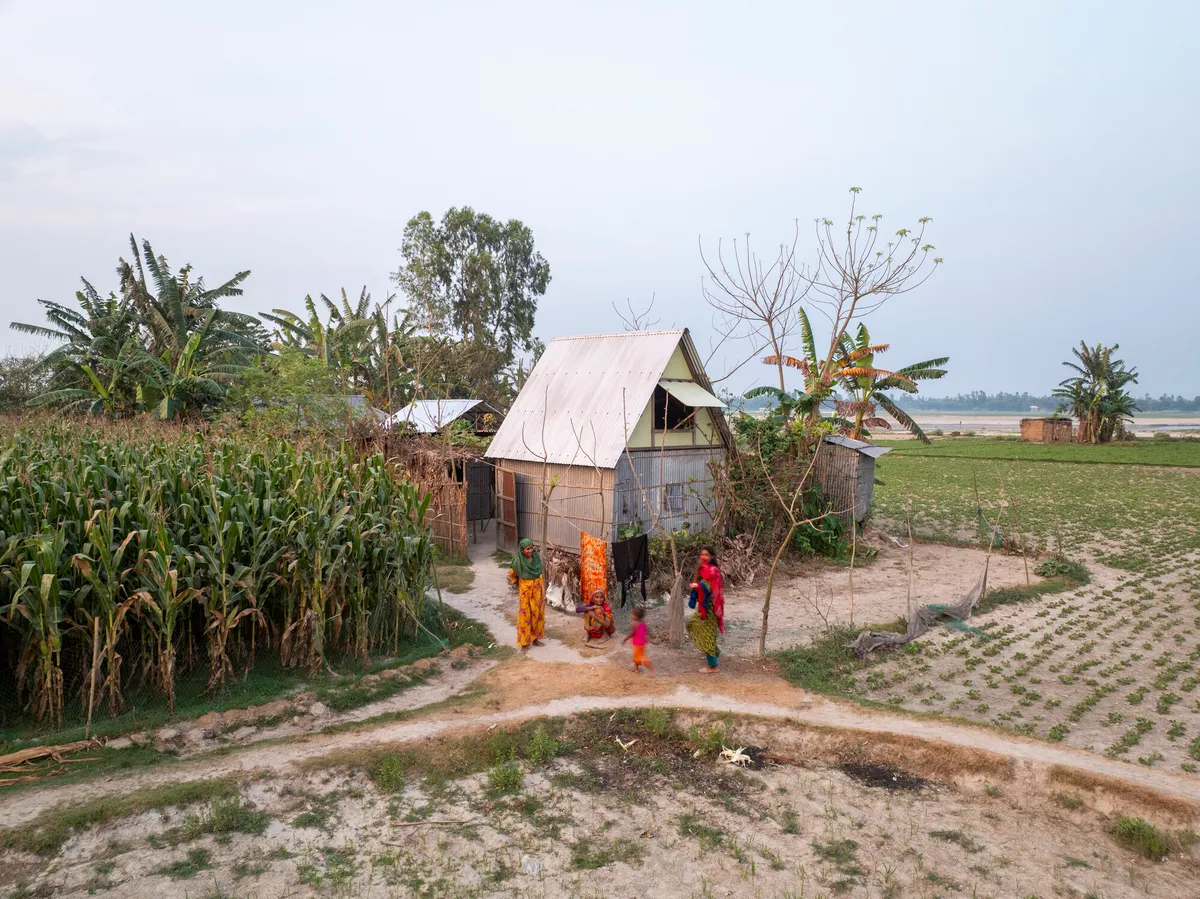
KHUDI BARI, CHAR JUAN SATRA, KURIGRAM DISTRICT, BANGLADESH. MARINA TABASSUM ARCHITECTS, 2020. PHOTO CITY SYNTAX © AGA KHAN TRUST FOR CULTURE.
The second project is the structural opposite of a mosque. Khudi Bari, Bengali for “little house,” is a modular two-storey structure made from bamboo and custom steel connectors fabricated in a Dhaka foundry. Three people can build one in three days. Three people can dismantle it in three hours. A single unit costs roughly four hundred and fifty dollars. The upper floor, raised above the flood line, serves as sleeping platform and refuge when the monsoon arrives. The lower floor is for daily life.
The context is Bangladesh’s chars: riverine sandbars shaped by Himalayan glacial melt, where land appears and disappears with each monsoon season. The communities who live on them have no tenure and no permanent address. In 2018, Tabassum’s office began a self-initiated research project into land rights along the Meghna River. The architecture that followed was not a building to place on a site. It was a building to carry from one site to the next.
The system has scaled. Through the Foundation for Architecture and Community Equity (FACE), the practice adapted the Khudi Bari into gathering spaces for women farmers and community hubs in the Rohingya refugee camps at Cox’s Bazar. The bamboo frame, once conceived as shelter, became something closer to infrastructure.
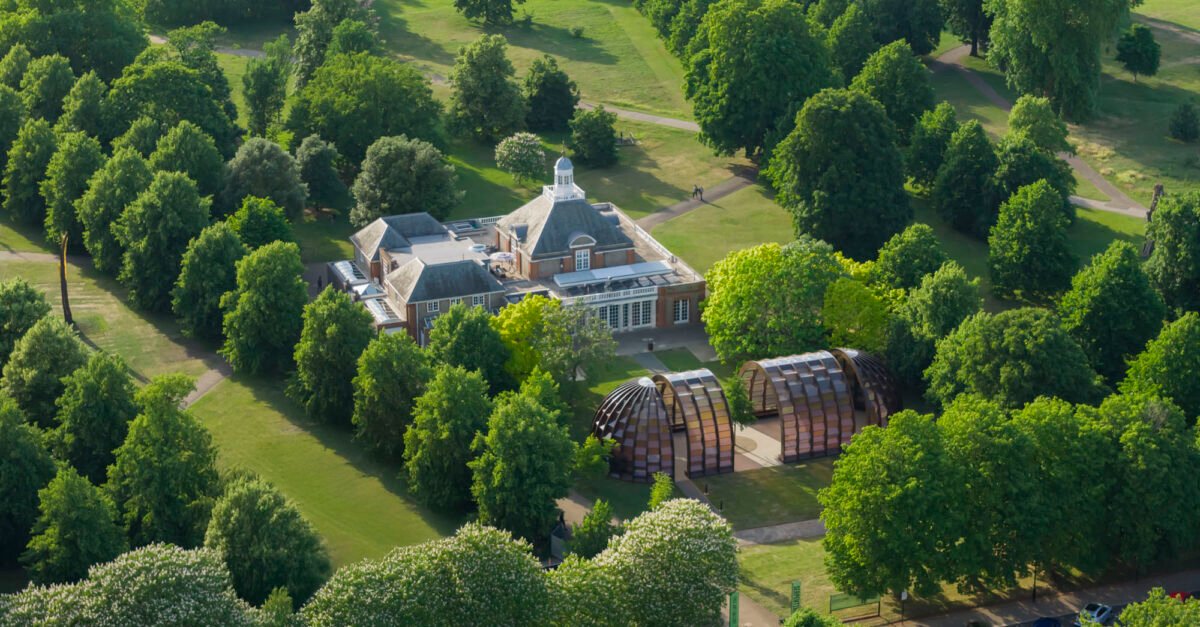
A CAPSULE IN TIME, SERPENTINE PAVILION 2025, KENSINGTON GARDENS, LONDON. MARINA TABASSUM ARCHITECTS. PHOTO IWAN BAAN © SERPENTINE GALLERIES.
In June 2025, Tabassum opened a different kind of structure entirely. A Capsule in Time, the 25th Serpentine Pavilion, was her first project built entirely in wood. Four arched timber forms wrapped in translucent polycarbonate panels filter light into the interior the way a canopy filters sun. She described the inspiration as shamianas, the ceremonial tents from her childhood in Dhaka, where light entered through fabric and everything felt provisional and alive.
II. THE FIELD
The institutional record is now considerable. Tabassum holds the 2021 Soane Medal, awarded previously to Rafael Moneo, Denise Scott Brown, and Kenneth Frampton. She holds the Gold Medal of the French Academy of Architecture, the Arnold Brunner Memorial Prize from the American Academy of Arts and Letters, and the Jameel Prize from the Victoria and Albert Museum. TIME named her one of its 100 Most Influential People in 2024. She held the Norman Foster Chair at Yale in 2023 and teaches at the Delft University of Technology as Professor of Architectural Design for Climate Adaptation. Her monograph, Marina Tabassum: Architecture, My Journey, was published by Architangle in 2023. She is the first Bangladeshi architect to win the Aga Khan Award twice.
None of that is why the work matters.
The two Aga Khan Award projects, taken together, dismantle a premise the discipline has carried for decades: that serious architecture must choose between permanence and responsiveness.
The mosque is permanent. The plinth sits on the earth and does not move. The Khudi Bari is portable. Its bamboo frame detaches from the ground and follows the family to the next sandbar. Both answer the same monsoon. Both use local materials and local labor. Both cost less than a single-family kitchen renovation in most Western cities. And both operate on the premise that architecture begins where the floor meets the water.
Tabassum’s practice remains deliberately small. She takes on a limited number of projects per year. This is not asceticism. It is a structural decision: the kind of work she does requires sustained time in the field and with communities before a line is drawn. The Bait Ur Rouf took seven years from commission to completion. The Khudi Bari began with a research project, not a brief.
The global conversation in architecture still tends to locate importance in proximity to certain cities and certain budgets. Tabassum’s career does not argue against that tendency. It simply ignores it. She builds in Dhaka, in the chars, in Cox’s Bazar, and when invited, in Kensington Gardens. The register does not change. The materials respond to the place. The question remains constant: how to build so that the building belongs to the people who will use it and to the ground it sits on, even when that ground is shifting under the rain.
FURTHER READING
Marina Tabassum: Architecture, My Journey. Architangle, 2023. The first monograph on Tabassum’s practice, spanning the Museum of Independence to the Khudi Bari, with essays by Sean Anderson, Hanif Kara, Andres Lepik, and Sarah M. Whiting on materiality, light, and community in her work.
Sources: Aga Khan Trust for Culture; Marina Tabassum Architects; Serpentine Galleries; Divisare; ArchDaily; Dezeen; Metalocus.
— The Home&Decor Editors