
FIELD NOTES
In 1917, Erik Satie composed music meant to exist in a room the way a chair exists. A century later, the same instruction shapes how architects design atmosphere.
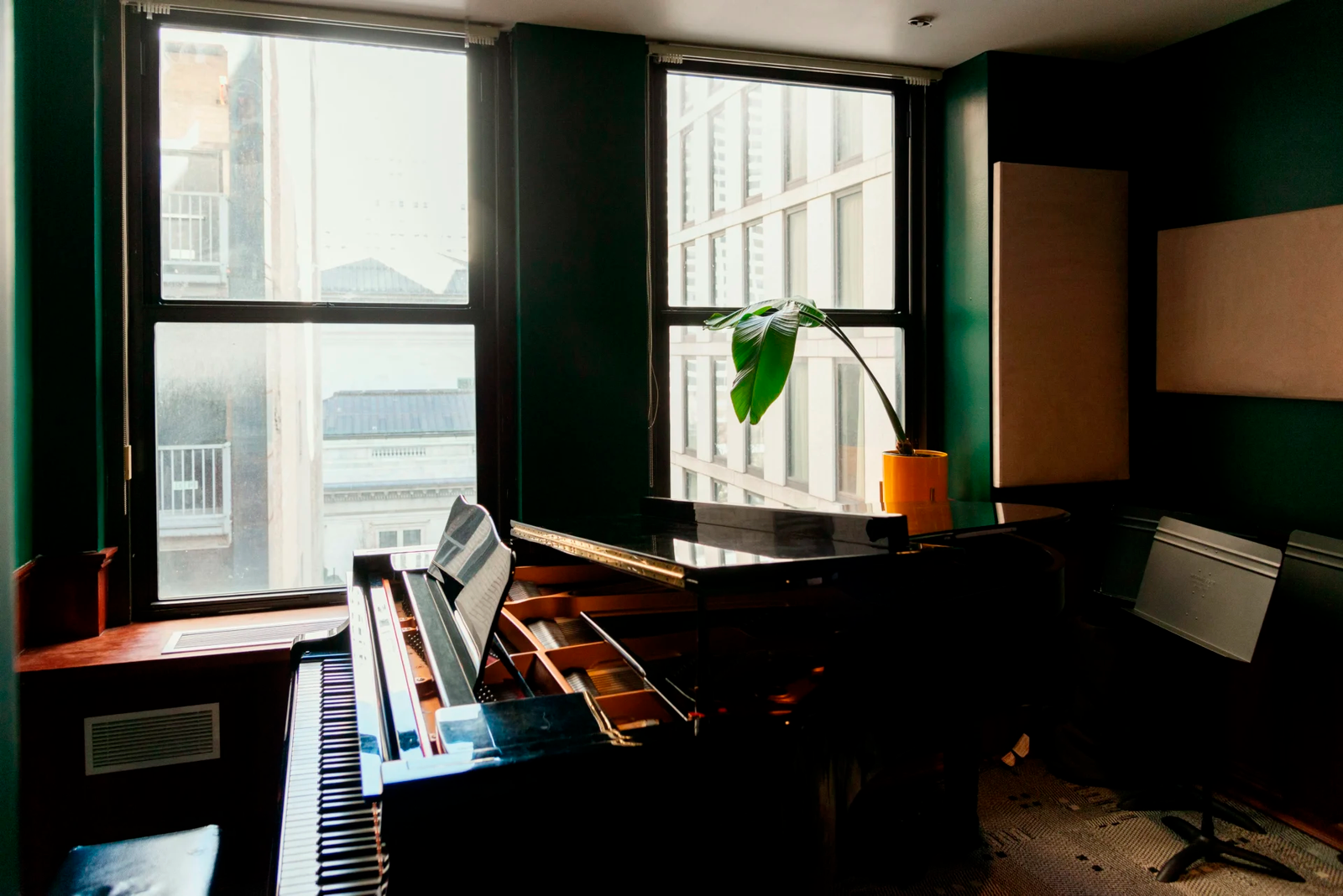
A PIANO AND A SCORE IN A ROOM. NO PERFORMER, NO AUDIENCE. THE INSTRUMENT EXISTS IN THE SPACE THE WAY A TABLE EXISTS.
On the evening of March 8, 1920, at the Galerie Barbazanges on the Rue du Faubourg Saint-Honoré, a small audience gathered for a soirée that included an exhibition of children’s drawings, music by Stravinsky and members of Les Six, and a staging of a now-lost comedy by Max Jacob. Between the acts, something else was meant to happen. Erik Satie and Darius Milhaud had written two short pieces, scored for piano duet, three clarinets, and a trombone, to be played during the intermissions. The instruments were placed not on stage but in the four corners of the room. The printed program carried an unusual request: behave during the intervals as if the music did not exist. It claims, the note read, to make a contribution to life in the same way as a private conversation, a painting in the gallery, or the chair in which you may or may not be seated.
The audience sat quietly and listened.
Satie had anticipated the failure. He is said to have walked through the gallery urging people to keep talking, to move around. The form was ahead of its audience. The two pieces, titled Chez un “Bistrot” and Un salon, belonged to a small body of work he had been developing since 1917 under the term musique d’ameublement: furniture music. The idea had come to him, according to the painter Fernand Léger, during a dinner at a Parisian restaurant where the two friends endured what Léger called unbearable vulgar music. Leaving the restaurant, Satie described a different kind of sound. Music that would be part of the ambience. That would soften the noise of knives and forks without dominating them. That would furnish the silences that sometimes fall between friends at a table and, at the same time, neutralise the street noise that forces itself into the conversation.
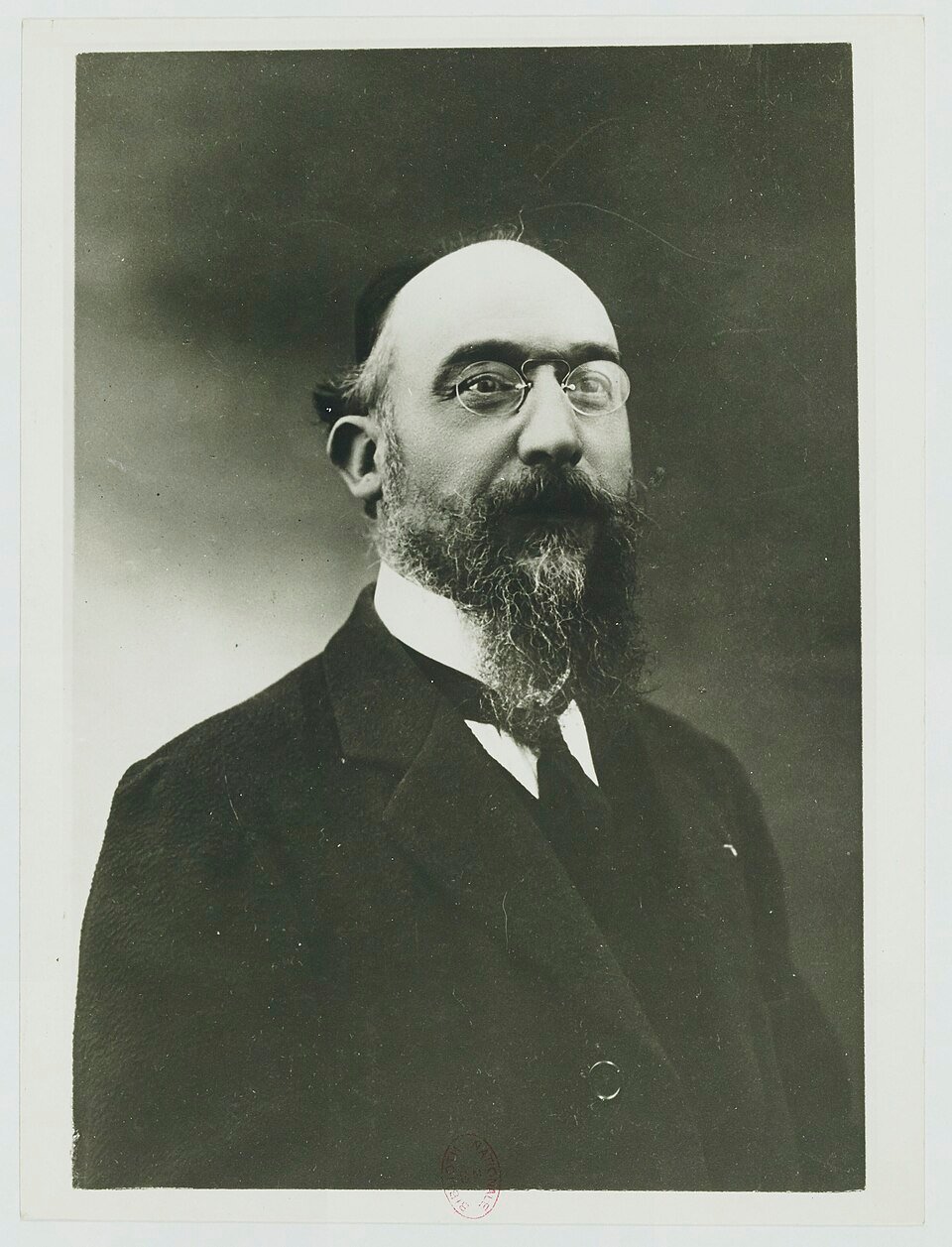
ERIK SATIE, C. 1910. PHOTOGRAPH, STUDIO HAMELLE. BIBLIOTHÈQUE NATIONALE DE FRANCE. PUBLIC DOMAIN.
He wrote five pieces between 1917 and 1923. Their titles read like architectural specifications. Tapisserie en fer forgé, Tapestry in forged iron, to be played in a vestibule, movement: very rich. Carrelage phonique, Phonic tiling, for a lunch or civil marriage, movement: ordinary. Tenture de cabinet préfectoral, Wall-lining in a chief officer’s office. Each was scored for small ensembles, designed to be repeated indefinitely, with no climax and no resolution. The music was not meant to begin or end. It was meant to be in the room.
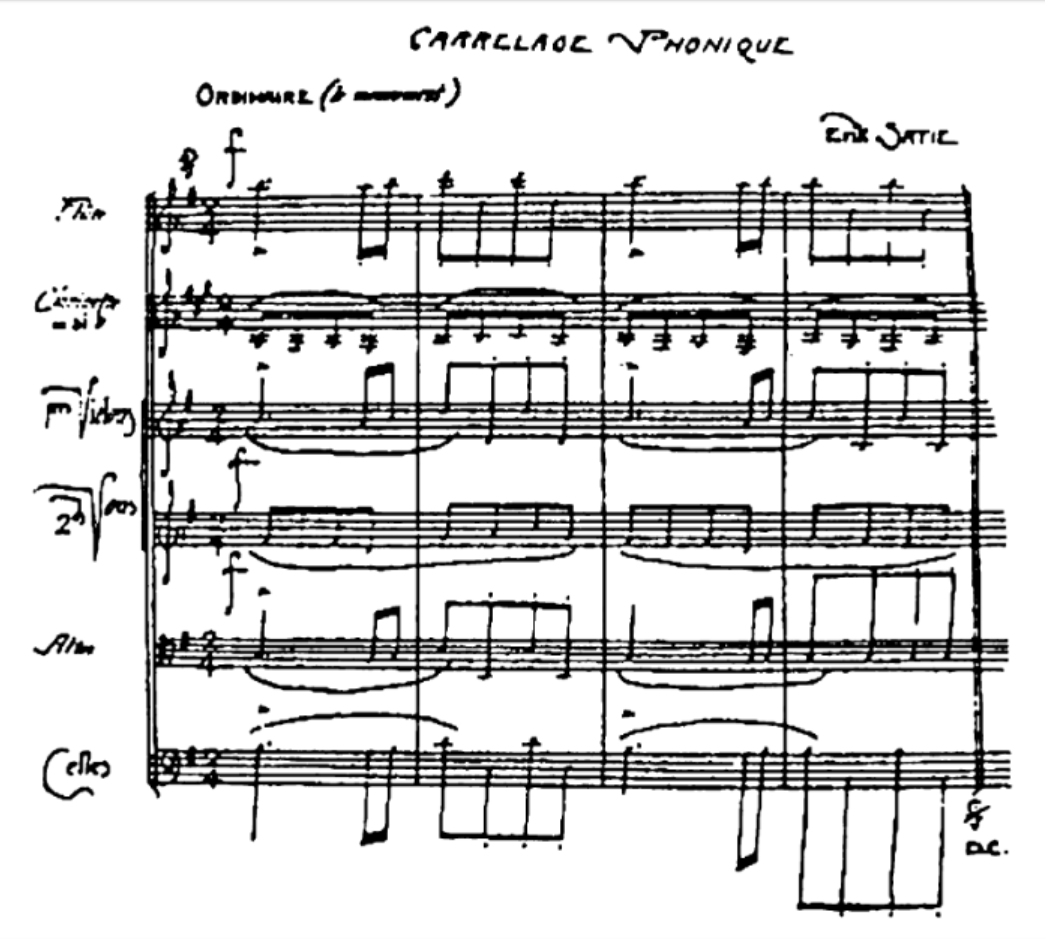
AUTOGRAPH MANUSCRIPT, CARRELAGE PHONIQUE (PHONIC TILING), ERIK SATIE, 1917. PUBLIC DOMAIN.
The proposition was so precise, and so far from what the concert hall assumed about listening, that it remained invisible for decades. Much of the furniture music was never performed during Satie’s lifetime. The scores stayed hidden for a quarter-century after his death, until John Cage, who called Satie indispensable, performed Vexations 840 times in a 1963 marathon and brought the forgotten composer back into the conversation. In 1978, Brian Eno carried the idea to its final name. His Music for Airports, the first record explicitly labeled “ambient,” proposed sound as a spatial material: designed for a specific building, meant to alter the atmosphere of a transit terminal without requiring attention. Eno knew of Satie through Cage. But Satie’s original language carried a different weight. Ambient describes what surrounds you. Ameublement describes what you place in a room. Sound conceived the same way you would choose a table or a lamp. Set in a space because the space calls for it, then left to exist without comment.

THERME VALS, GRAUBUNDEN, SWITZERLAND. PETER ZUMTHOR, 1996. PHOTO FABRICE FOUILLET.

The distinction matters because the best contemporary architecture already operates by the same instruction. Peter Zumthor, in his 2006 lecture Atmospheres, describes the acoustic quality of a building as a design material equal to stone or light. At the Therme Vals, completed in 1996 in the Swiss Alps from locally quarried Valser quartzite, the sound of water against stone is not incidental. It is calibrated. The pools are dimensioned so that the sound neither echoes nor deadens. The corridors are proportioned so that footsteps arrive softly and leave. Zumthor did not compose the sound. He composed the conditions under which the sound could exist in the room without performing.
THERME VALS INTERIOR. PETER ZUMTHOR, 1996. PHOTO FABRICE FOUILLET.
Satie died on July 1, 1925, at the age of fifty-nine. He had lived in a single room in Arcueil, an industrial suburb south of Paris, for twenty-seven years. He permitted no visitors. After his death, his friends opened the door for the first time and found two grand pianos stacked one on top of the other, the upper instrument used for storing letters and parcels. More than a hundred umbrellas. Unpublished manuscripts across every surface. In the pockets of a gray velvet suit he believed he had lost on a bus years earlier, they found notes to himself. One read: Be invisible for a moment.
The composer who invented music meant to be ignored had lived in a room no one was allowed to see.
FURTHER READING
Erik Satie: A Parisian Composer and his World, by Caroline Potter. Boydell Press, 2016. The most rigorous English-language study of Satie’s career, with a dedicated chapter on the furniture music and its three stages of evolution from decorative concept to radical provocation.
Atmospheres: Architectural Environments, Surrounding Objects, by Peter Zumthor. Birkhäuser, 2006. A slim lecture on the nine elements Zumthor weighs when designing a building’s atmosphere, from the temperature of a room to the sound between its walls.
Sources: La Revue Musicale (Léger, 1952); Galerie Barbazanges historical record; Caroline Potter, Erik Satie: A Parisian Composer and his World (Boydell Press, 2016); Gillmor, Erik Satie (1988); Sonic Field; Open Culture; Peter Zumthor, Atmospheres (Birkhäuser, 2006); ArchEyes.
— The Home&Decor Editors