
SOURCE MATERIAL
John Lautner’s impossible houses have appeared in more films than the work of any other Los Angeles architect. Almost none of those appearances reads the architecture.

THE CHEMOSPHERE (MALIN RESIDENCE), HOLLYWOOD HILLS, LOS ANGELES. JOHN LAUTNER, 1960. PHOTO: JULIUS SHULMAN / JOHN LAUTNER FOUNDATION.
I. THE IMPOSSIBLE HOUSES
In 1960, a young aerospace engineer named Leonard Malin handed John Lautner a hillside lot with a 45-degree slope and thirty thousand dollars. The lot had been declared unbuildable. Lautner spent weeks pacing the hill at night, produced four rejected drafts, and then did what no one had considered: he sank a concrete pedestal nearly twenty feet in diameter into the bedrock and raised the entire house on a single column, five feet wide, nearly thirty feet tall. The octagon floats above the San Fernando Valley like something that arrived from elsewhere and never left. The Encyclopaedia Britannica called it the most modern home built in the world. A funicular carries residents from the carport to the front door.
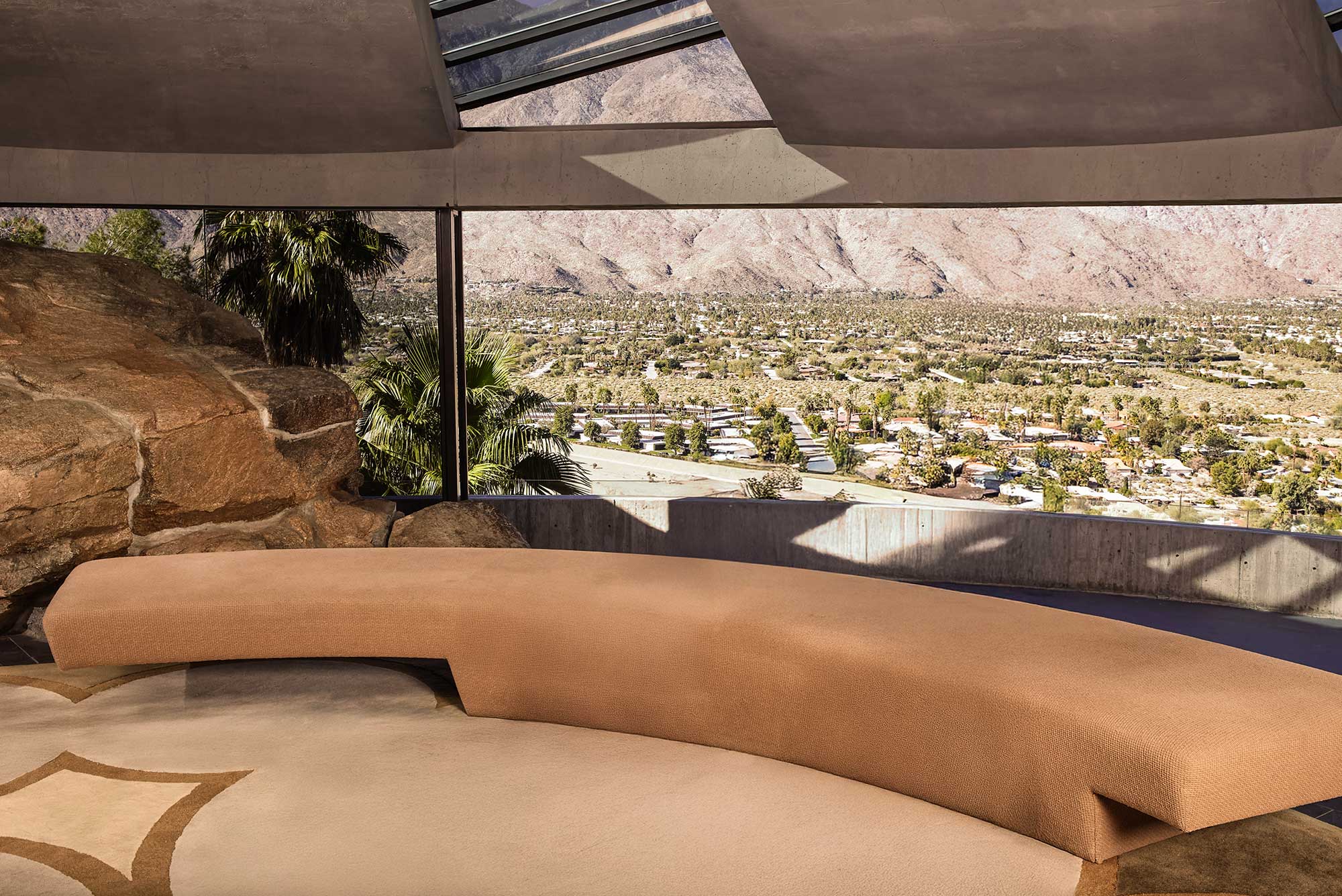
Eight years later, in Palm Springs, interior designer Arthur Elrod told Lautner to give him what Lautner thought he should have. The result sits on the edge of Southridge, overlooking the Coachella Valley: a circular living room sixty feet in diameter, covered by a concrete dome whose nine petals alternate between solid and glass. Boulders from the hillside run through the walls and into the room. The floor is black slate cut into rectangles that read like parquet. There are no boundaries between the rock, the concrete, and the view of Mount San Jacinto. Elrod furnished it himself. Lautner built the architecture around the mountain, and the mountain stayed.
ELROD HOUSE, PALM SPRINGS. JOHN LAUTNER, 1968. PHOTO: KATE MARTIN / HOLLYWOOD AUTHENTIC.
Then there is the Sheats-Goldstein Residence, built between 1961 and 1963 in Beverly Crest. Lautner carved a dwelling into a sandstone ledge above Benedict Canyon: angled concrete, glass falling toward the valley, a coffered ceiling embedded with more than 750 cast drinking-glass skylights that scatter daylight into shifting patterns across the living room floor. The living room opens entirely to the terrace, separated from the outside by nothing more than a forced-air curtain. There are no walls between the house and Los Angeles. Even the bathroom is open to the sky.
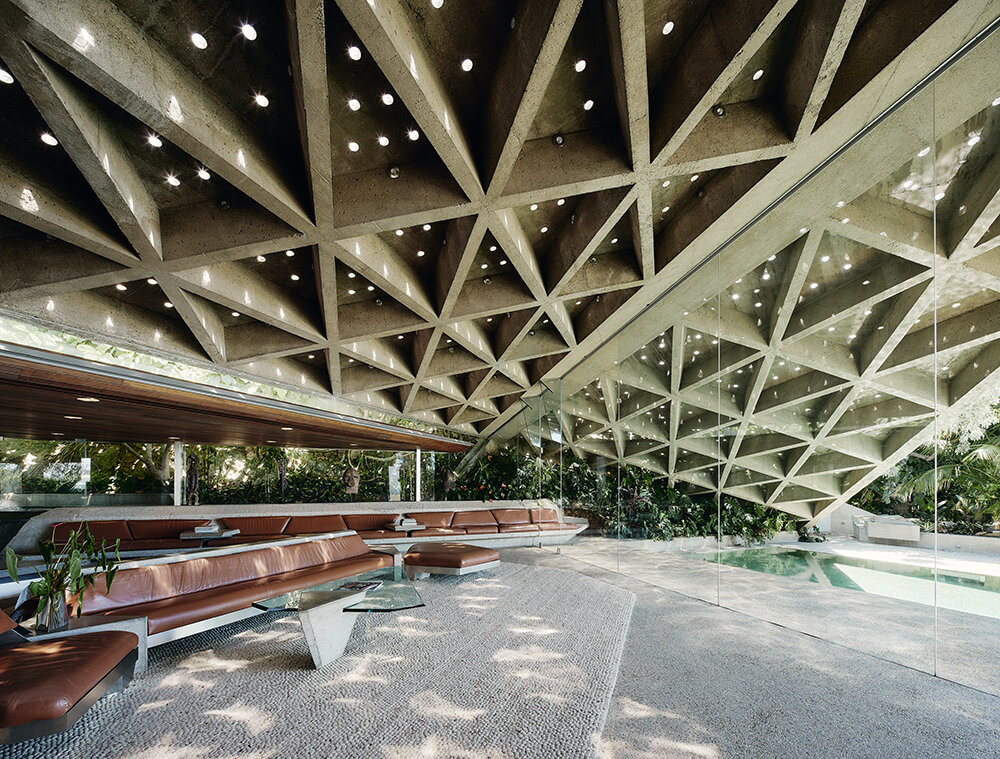
SHEATS-GOLDSTEIN RESIDENCE, BEVERLY CREST, LOS ANGELES. JOHN LAUTNER, 1961-1963. PHOTO: JOE FLETCHER.
These three houses share a conviction. Lautner apprenticed under Frank Lloyd Wright at Taliesin from 1933 to 1939, but where Wright composed with horizontal planes and prairie grasses, Lautner built with the impossible: a column on an unbuildable slope, a dome over desert boulders, a glass ceiling on a sandstone ledge. He designed over two hundred projects across a fifty-five-year career, and the best of them feel engineered against probability, as if the site tried to refuse the building and the building simply stayed.
II. THE SCENERY
In 1971, Sean Connery was thrown into Elrod’s pool by two bikini-clad bodyguards in Diamonds Are Forever. The production designer, Ken Adam, walked into the house and said it was as though he had designed it himself, that he did not need to change anything. In 1984, Brian De Palma used the Chemosphere as a voyeur’s perch in Body Double. In 1998, the Coen Brothers turned Sheats-Goldstein into a porn mogul’s lair in The Big Lebowski. Jeff Bridges walked in and noted, with characteristic understatement, that it was quite a pad.
Lautner is the most cited architect in Los Angeles and, by almost any measure, the least read.
The list continues. Charlie’s Angels: Full Throttle. Snoop Dogg and Pharrell. Doja Cat. Herb Ritts. Helmut Newton. Jimmy Choo. Fashion editorials in every decade since the seventies. The Sheats-Goldstein alone generates a reported half-million dollars a year in location fees. Lautner’s houses have been cast as villain lairs, bachelor pads, symbols of decadence, backdrops for swimwear and slow-motion choreography. In virtually every appearance, the camera treats the architecture the way a music video treats a rented sports car: it borrows the silhouette and returns nothing.
The problem is not obscurity. The problem is the opposite. Lautner’s houses are so visually available, so frequently photographed from the same angles, that they have been consumed as images rather than as buildings. The angled concrete of Sheats-Goldstein registers as “luxury” in a Snoop Dogg video the same way it registers as “villainy” in a Bond film: through mood, not through any reading of how the ceiling distributes light, how the forced-air curtain replaces a wall, how the skylights are literally drinking glasses cast into a concrete grid. The architecture is present. The architectural literacy is absent.
III. THE READING

GOLDSTEIN ENTERTAINMENT COMPLEX, SHEATS-GOLDSTEIN ESTATE. CONNER + PERRY ARCHITECTS. PHOTO: JOE FLETCHER.
In 1972, businessman James Goldstein purchased the Sheats-Goldstein Residence from its third owners and began a partnership with Lautner that would last until the architect’s death in 1994. The two spent twenty-two years, as Goldstein put it, perfecting the house: upgrading materials, installing frameless glass, adding a koi pond entryway, building the pool with a zero edge, designing built-in concrete and glass furniture. Every detail, including where the stitching falls on the leather, was worked and reworked. Goldstein also purchased the neighbouring Concannon Residence (another Lautner) as the future site of a tennis court and guest house. Lautner had blessed the plans before he died.
Below the residence, on a steep slope, Goldstein commissioned light artist James Turrell to build Above Horizon, a skyspace conceived as a collaboration between Turrell and Lautner. Lautner did not live to see it. Duncan Nicholson, his apprentice and associate, completed the installation in 2004: two folding carbon-fibre portals, a built-in concrete lounge, thousands of hidden LEDs. The room sits in the hillside like an eye trained on the sky. It is constructed with the same materials as the house above it. The Turrell reads the Lautner, and the Lautner reads the canyon, and the canyon reads the light.
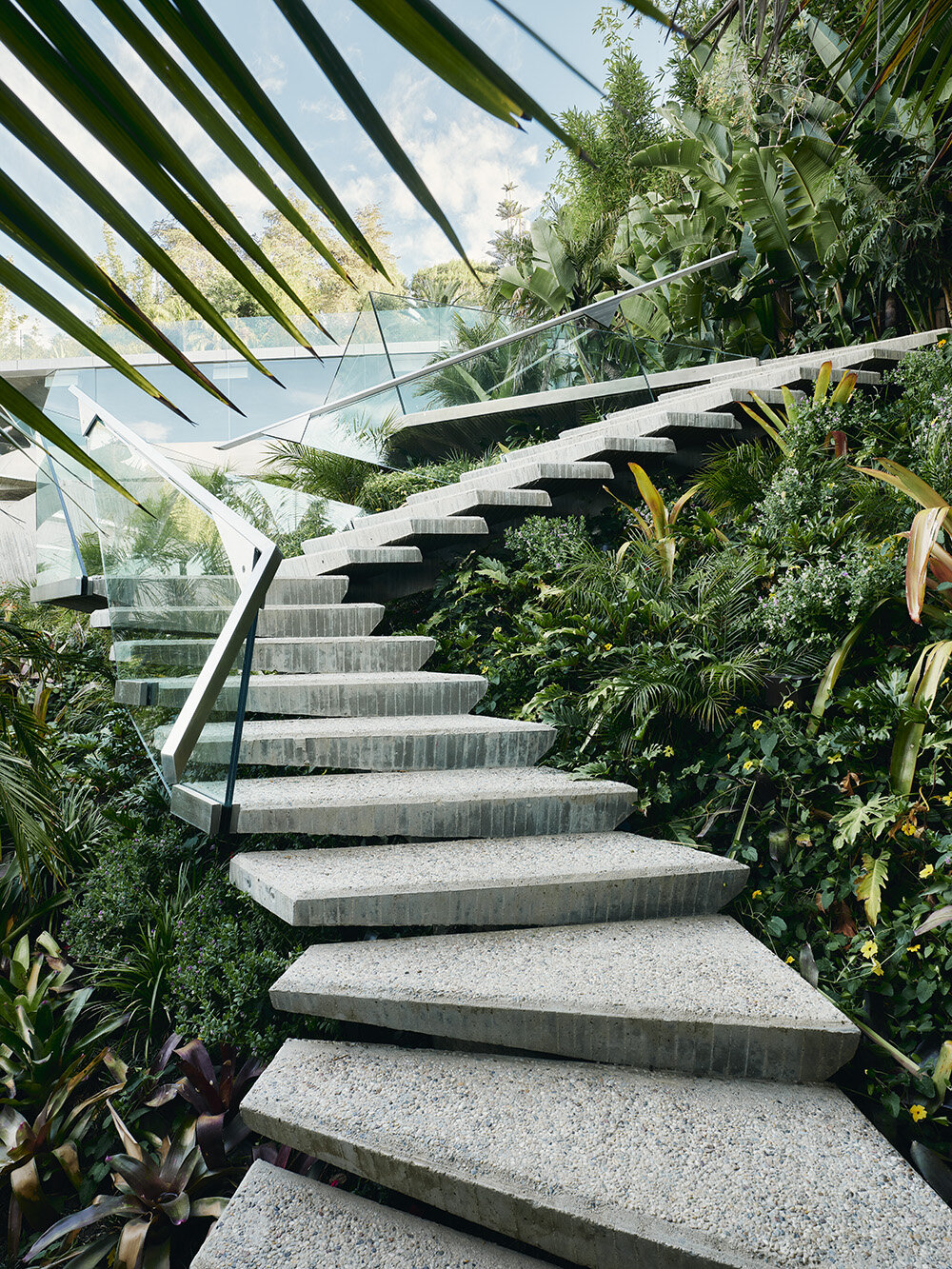
CONCRETE PATHWAYS THROUGH THE SHEATS-GOLDSTEIN HILLSIDE. LANDSCAPE: ERIC NAGELMANN. PHOTO: JOE FLETCHER.
In 2016, Goldstein promised the entire estate to the Los Angeles County Museum of Art: the house, the land, the Turrell, the architectural models, the art collection, a 1961 Rolls-Royce Silver Cloud parked on the property, and an endowment for maintenance and preservation. It was LACMA’s first architectural acquisition. Michael Govan, the museum’s director, said great architecture was as powerful an inspiration as any artwork. What he meant, in practice, was that the building would finally enter a curatorial frame: exhibitions, public access tours, architecture students, scholars. After sixty years of cameras, someone would read the drinking-glass skylights as structure rather than as atmosphere.
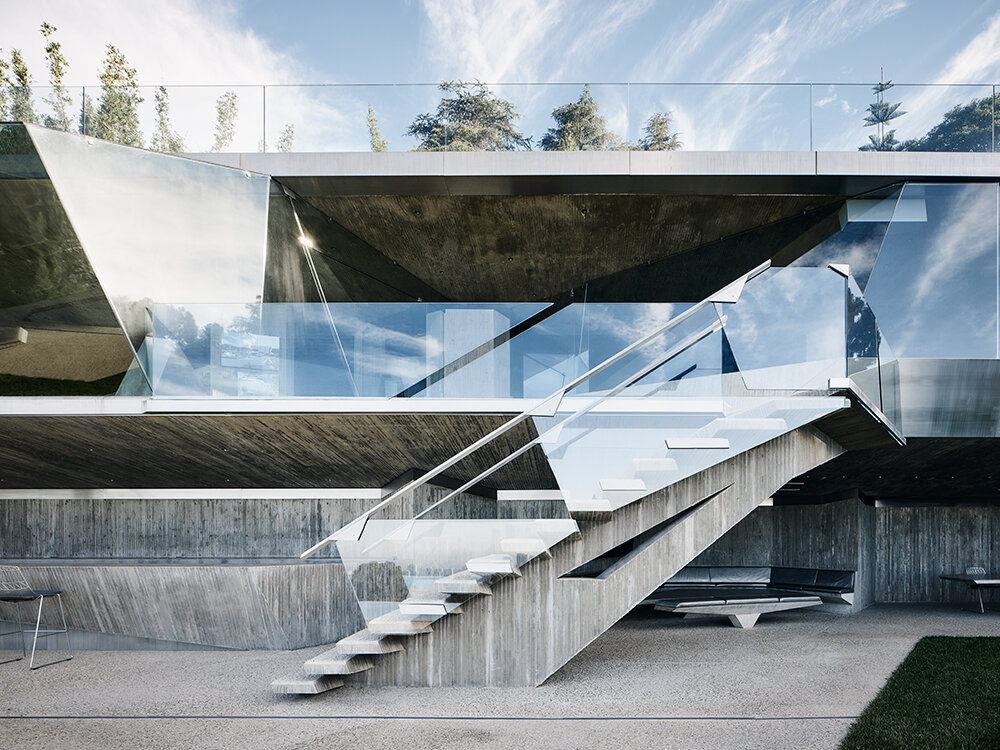
GOLDSTEIN ENTERTAINMENT COMPLEX, EXTERIOR. CONNER + PERRY ARCHITECTS, ONGOING. PHOTO: JOE FLETCHER.
The work continues on the hillside. Conner + Perry Architects, who took over from Nicholson in 2015, now oversee both the restoration of the original residence and the design of the Goldstein Entertainment Complex beneath the tennis court. Their approach, by their own account, treats each new structure as an evolution of the house’s original language, adapting it to new functions without breaking the vocabulary. The same concrete, the same refusal of parallel walls. When the project is complete, the property will include a nightclub, a screening room, a guest house near the Turrell, and a reception area. All of it built in Lautner’s grammar, decades after his death.

There is a concrete bench sofa in the living room that begins inside the house and continues, without interruption, through a glass wall to the terrace outside. The glass is frameless. The concrete is continuous. If you are sitting on it, you cannot tell the moment you cross from interior to exterior. Lautner spent his career erasing that boundary, and the bench is the simplest proof that he succeeded. No camera has ever lingered on it.
The houses played themselves in every film they appeared in. They were never acting. It took sixty years for someone to notice.
CODA
Lautner once said he had never designed a facade in his life. A building without a facade is a building that cannot be photographed in the way architecture usually is: front elevation, clean geometry, the thing as object. His houses resist objectification. They ask to be entered, walked through, sat in. They ask to be read from the inside, the way a room is read, not from the outside, the way a set is framed. When LACMA opens the Sheats-Goldstein to public tours, the visitors will do what sixty years of cameras declined to do. They will walk in, sit on the concrete bench, and watch the light move through 750 drinking glasses overhead.
FURTHER READING
John Lautner, Architect, edited by Frank Escher. Princeton Architectural Press, 1998. Designed in collaboration with Lautner before his death in 1994, covering nearly fifty houses with detailed drawings, photographs, and an interview in which Lautner discusses his work in his own voice.
Between Earth and Heaven: The Architecture of John Lautner, edited by Nicholas Olsberg, with Jean-Louis Cohen and Frank Escher. Rizzoli, in association with Hammer Museum, 2008. The first comprehensive scholarly examination of Lautner’s full body of work, with previously unpublished drawings, construction images, and his own photographs.
Sources: John Lautner Foundation; Los Angeles County Museum of Art (LACMA); LA Conservancy; SAH Archipedia; Conner + Perry Architects; A+D Museum, Los Angeles; Murray Grigor, Infinite Space: The Architecture of John Lautner (documentary, 2008). Photographs: Julius Shulman (Chemosphere); Kate Martin (Elrod House, via Hollywood Authentic); Joe Fletcher (Sheats-Goldstein Residence and Goldstein Entertainment Complex).
— The Home&Decor Editors