
AN ADDRESS
A library in a Chinese mountain village, clad in forty-five thousand sticks of the firewood its neighbors burn to cook.
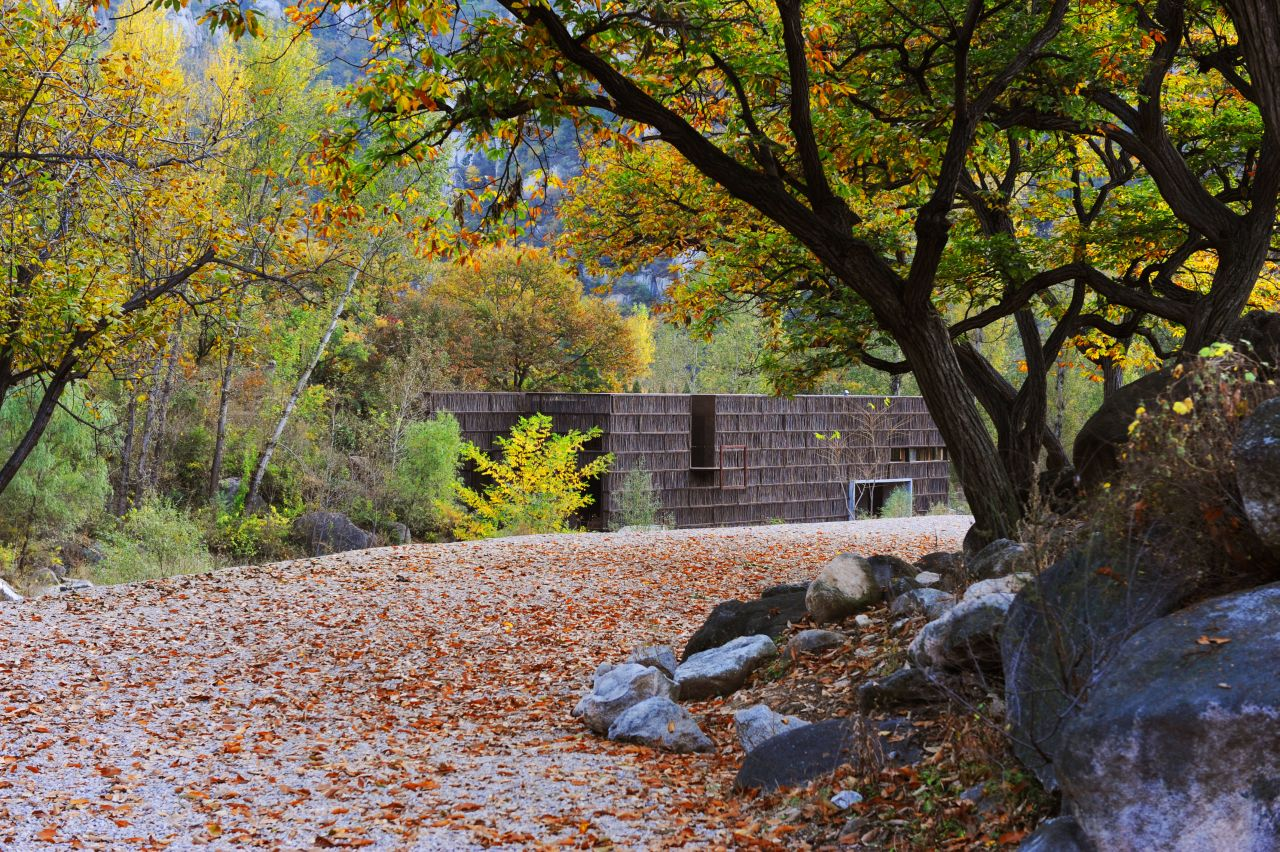
LIYUAN LIBRARY, JIAOJIEHE VILLAGE, HUAIROU DISTRICT, BEIJING. LI XIAODONG ATELIER, 2011. PHOTOGRAPH © LI XIAODONG.
Jiaojiehe sits in the Huairou mountains, ninety minutes north of Beijing. Two hundred people, sixty households, a single road that bends uphill past stacked firewood and stone courtyards. The nearest section of the Great Wall is close enough to draw tourists. The village itself draws none.
In 2010, Li Xiaodong drove out from Beijing with classmates and stayed for dinner in one of the courtyards. He noticed two things: the children had nowhere to read, and every house had the same material piled against its walls. Birch and poplar sticks, cut to arm’s length, drying in rows for the cooking stoves. The village’s most ordinary possession.
He built the library from that material.
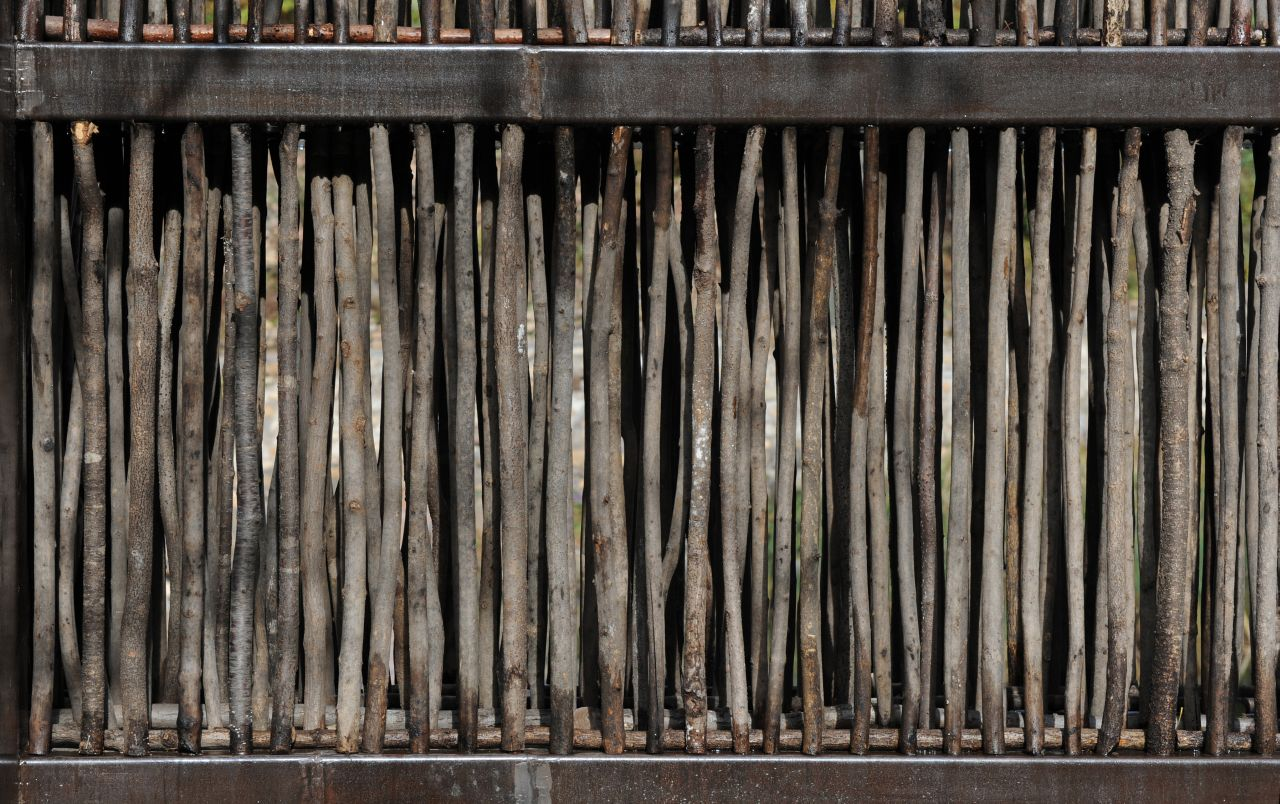
The Liyuan Library sits not in the village but five minutes uphill, at the edge of a still pond, on a rock shelf at the lowest point of Wisdom Valley. Steel frame, tempered glass walls, a box thirty meters long and four meters wide. The structure is modern and transparent. What conceals it is the cladding: forty-five thousand sticks, harvested from the same woods as the firewood, arranged vertically across every facade and across the roof. From a distance, the building reads as a thicket. In winter, when the trees on the mountain lose their leaves, the library and the forest are the same color.
FACADE DETAIL. LOCALLY SOURCED BIRCH AND POPLAR, UNTREATED, HELD IN BURNISHED STEEL FRAMES OVER TEMPERED GLASS. PHOTOGRAPH © LI XIAODONG.
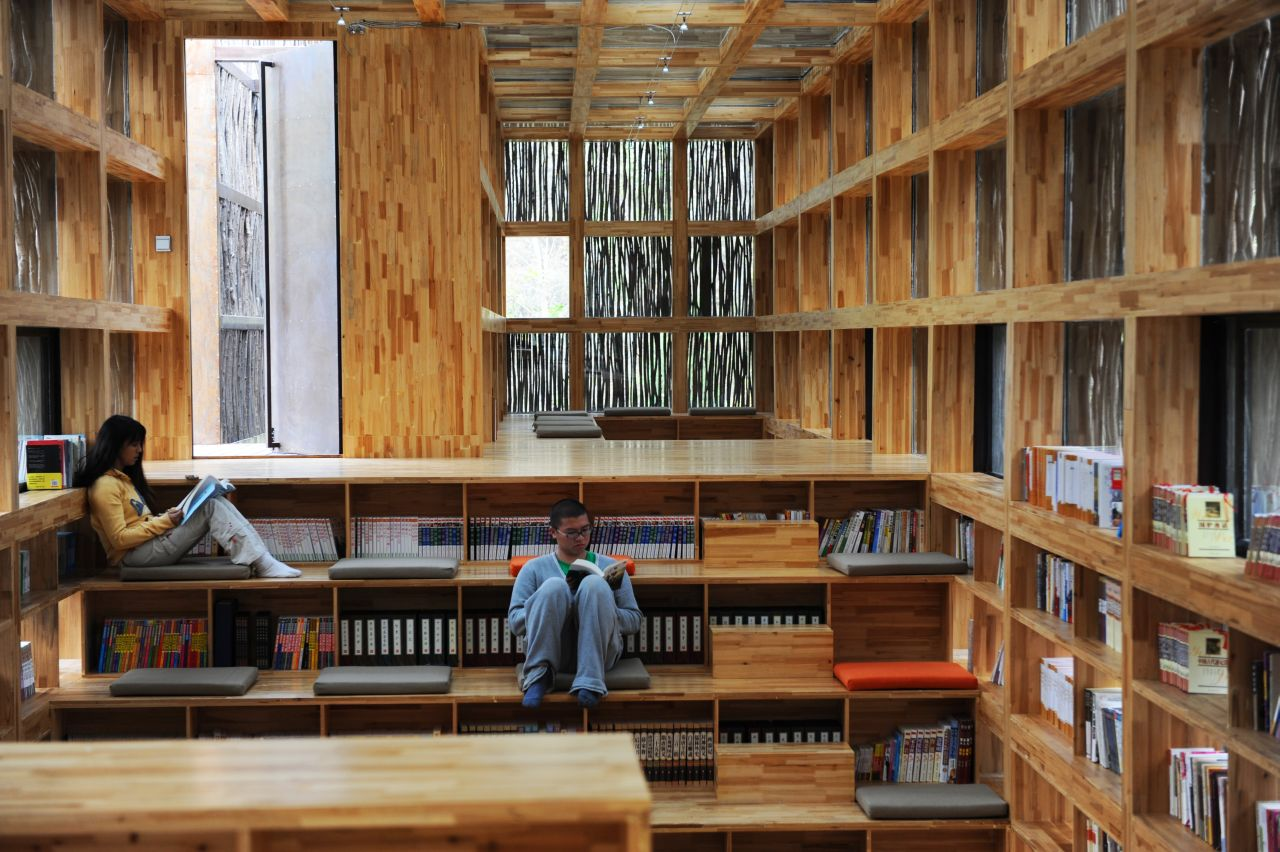
THE INTERIOR READING ROOM. TIMBER PLATFORMS SERVE AS STAIRS, SEATING, AND SHELVING IN A SINGLE CONTINUOUS VOLUME. PHOTOGRAPH © LI XIAODONG.
Inside, the sticks become a different instrument. Daylight enters the glass walls and passes through the irregular lattice, scattering into a soft, even glow that needs no artificial supplement. The reading rooms step up and down in half-levels: wooden platforms that serve simultaneously as stairs, chairs, and shelving. Timber lattice frames line the walls, holding books and framing rectangular views of the mountain. The plan is seamless. There are no doors between the levels, no partitions. A single volume with its own quiet geography.
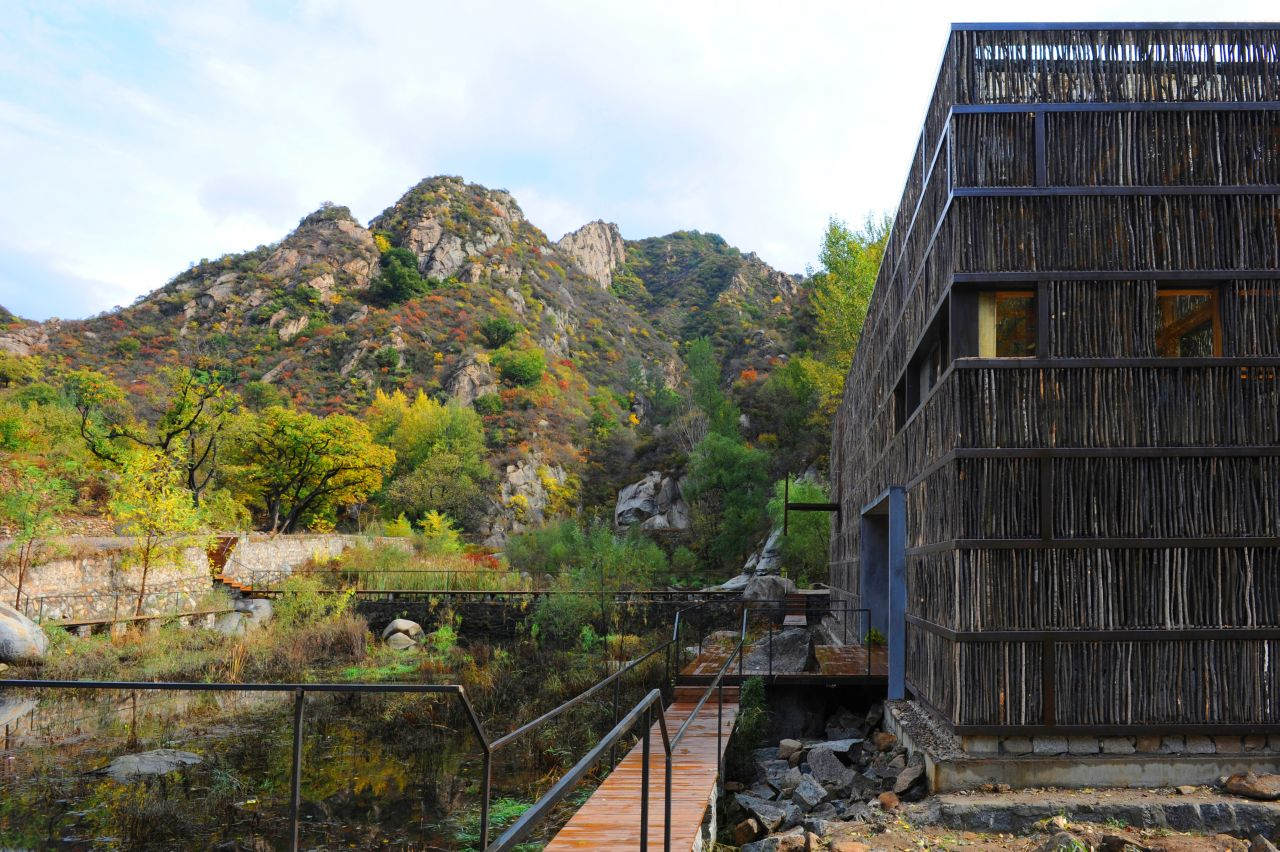
The entrance sits at the waterline. A wooden boardwalk crosses the pond, passes over pebbles arranged on the shore, and drops below the natural ground level to meet the building. In summer, cool air from the water surface enters through the low door and rises through the space, pulling warm air toward a high opening near the roof. The building adjusts to the season the way the village does: without machinery.
Li Xiaodong funded the construction through a rural development grant from the Luke Him Sau Charitable Trust in Hong Kong. The building period ran seven months, March to October 2011. It opened in May 2012 with empty shelves and a single policy: bring two books, take one. Within months the shelves were full. Within two years the village needed a new bus stop.
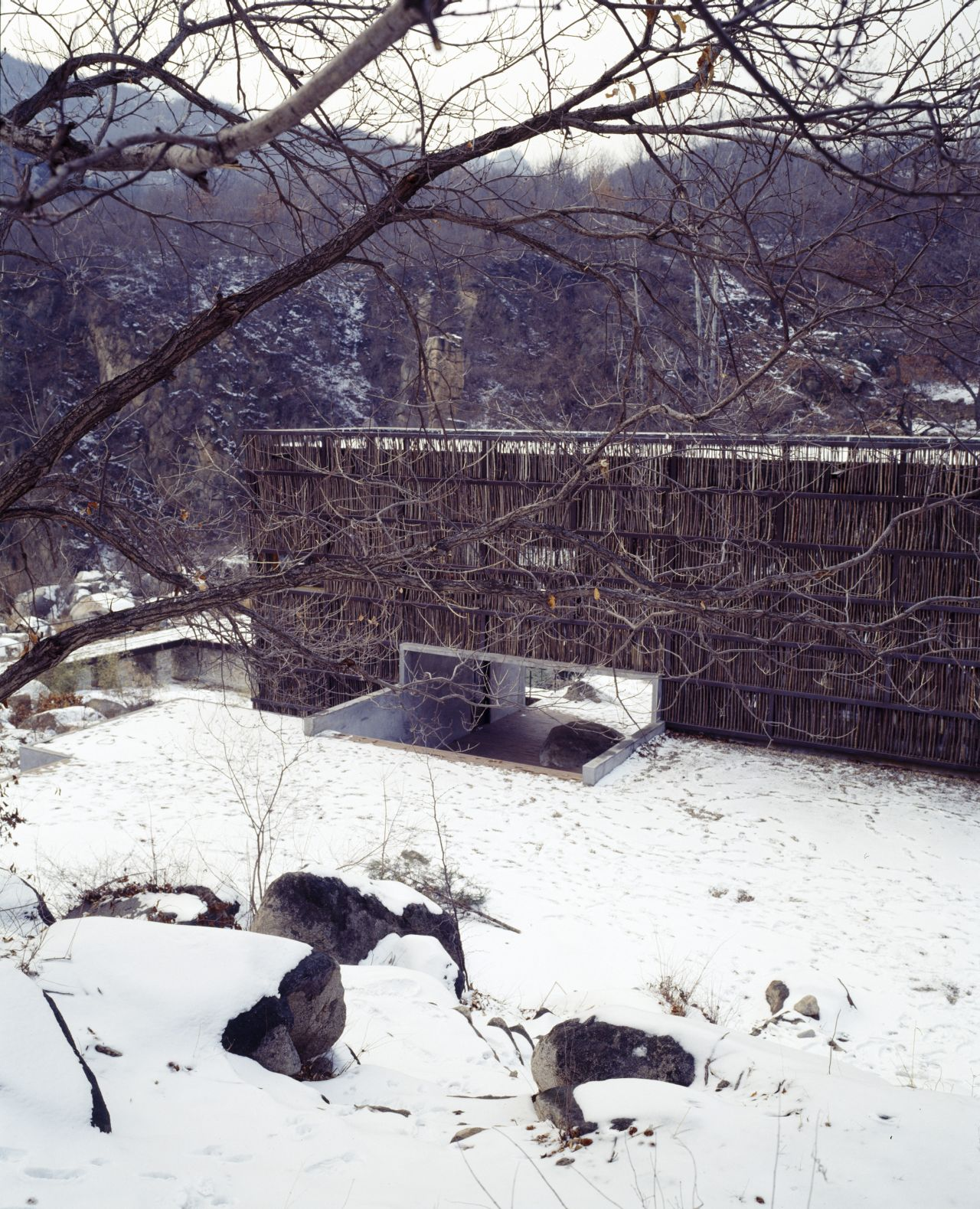
In 2014, the library received the inaugural Moriyama RAIC International Prize, a hundred-thousand-dollar award for a building that cost roughly twice that to construct. It had already won a World Architecture Festival award in 2012 and Sweden’s Architecture of Necessity prize the following year. Li Xiaodong, a professor at Tsinghua University who calls himself a regionalist, does not copy traditional forms. He reads conditions: the firewood against the wall, the children without a book, the mountain that no new building should try to match.
The sticks will not last forever. They are not treated or coated. Li expects birds to nest in them, vines to climb through the gaps, the color to shift with each season. The building came from the forest, and it will return to it. In the meantime, it is the only structure in Wisdom Valley: a library that reads as a hillside, in a village where neighbors now share their firewood with strangers.
Liyuan Library, Jiaojiehe.
Sources: Li Xiaodong Atelier; Archnet (Aga Khan Trust for Culture); Royal Architectural Institute of Canada; Arquitectura Viva; The Plan; ArchDaily. Photography © Li Xiaodong.
— The Home&Decor Editors