
SOURCE MATERIAL
Donald Judd’s discipline of permanent installation finds its quietest heir in a villa north of Milan. Neither architect names the connection.
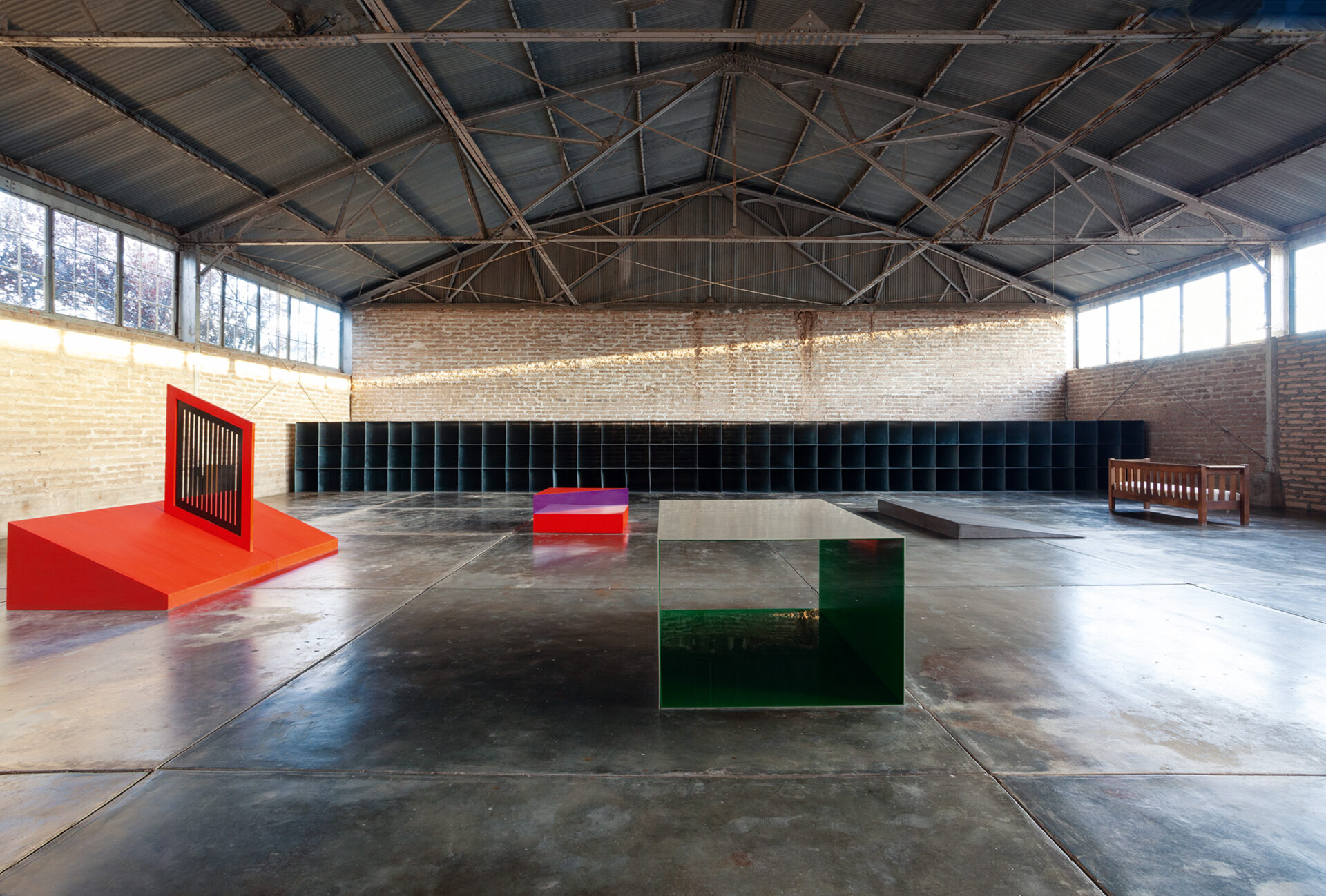
LA MANSANA DE CHINATI / THE BLOCK, JUDD FOUNDATION, MARFA, TEXAS. PHOTO ELIZABETH FELICELLA © JUDD FOUNDATION.
I. MARFA
In the winter of 1971, Donald Judd drove into a town of under two thousand people in the Chihuahuan Desert and stayed. By 1973 he had begun buying buildings. The first two were former warehouses on a city block in downtown Marfa, originally offsite storage for the neighboring army base, Fort D.A. Russell, which had been decommissioned after the second world war and subsequently served Webb Brothers Automotive as a yard for wrecked vehicles. He added the two-story Quartermaster’s office the following year. He called the property La Mansana de Chinati, after the mountains on the horizon. In English he called it the Block.
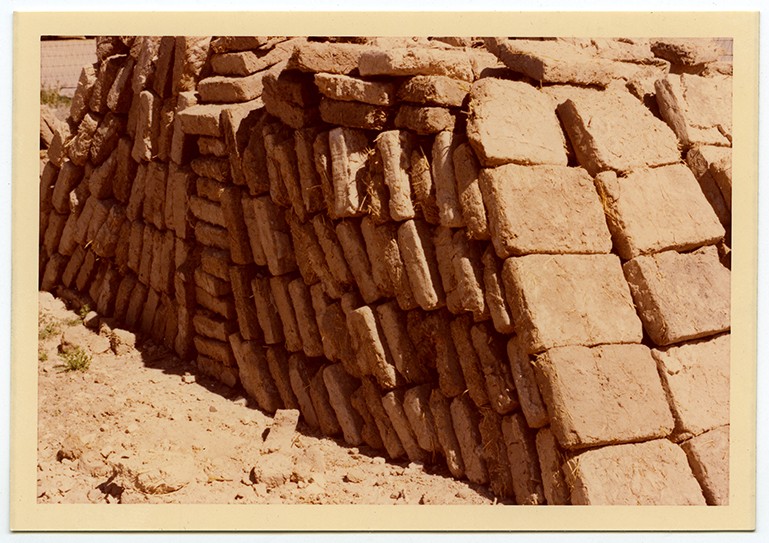
Before he installed a single work, Judd built a wall. Between 1973 and 1979 he wrapped the complex in a nine-foot adobe perimeter, 1,441 feet in total, roughly thirty thousand bricks, much of it salvaged from the demolished Toltec Motel and Virginia Hotel. He designed the top of the wall to meet the sill of the clerestory windows of the east warehouse. The first architectural gesture at Marfa was not an installation. It was the making of the ground on which installation would become possible.
ADOBE BRICKS FOR THE BLOCK / LA MANSANA DE CHINATI, 1975. IMAGE JAMIE DEARING © JUDD FOUNDATION. JAMIE DEARING ARCHIVE, JUDD FOUNDATION ARCHIVES, MARFA, TEXAS.
What Judd did inside those walls was the slow conversion of ordinary buildings into architecture of permanent installation. Floors were restored, not replaced. Window openings kept their original rhythm. The east warehouse held his sculpture from the sixties and seventies. The west warehouse held both sculpture and the library. The two-story house became the family kitchen, dining room, and bedrooms. The furniture was built by Judd, in pine, to the measurements of the rooms.
By the early nineties the library had grown past its first home and was reorganized into two rooms. A south library, for the pre-twentieth-century volumes, organized by country and region. A north library, set into Judd’s former print and drawing studio, for the twentieth century. Over thirteen thousand books between them, arranged by hand, still shelved as he left them. Visitors walking through in 2026 enter a living-working space stopped mid-sentence in 1994, the year Judd died. The library is the room most people remember afterwards. It is the room where the discipline becomes visible as reading, not as theory.
A short drive south of the Block, on 340 acres of the former fort, sits the institution Judd built for other artists and for his own work he could not install at home. The Chinati Foundation opened in 1986. The first works installed on the grounds were his own: fifteen untitled works in concrete, 1980 to 1984, cast and assembled on site from slabs twenty-five centimeters thick. Each of the fifteen is composed of multiple units of identical measurement, 2.5 by 2.5 by 5 meters, running along the eastern edge of the property. From a distance, they dissolve into the desert they sit on.
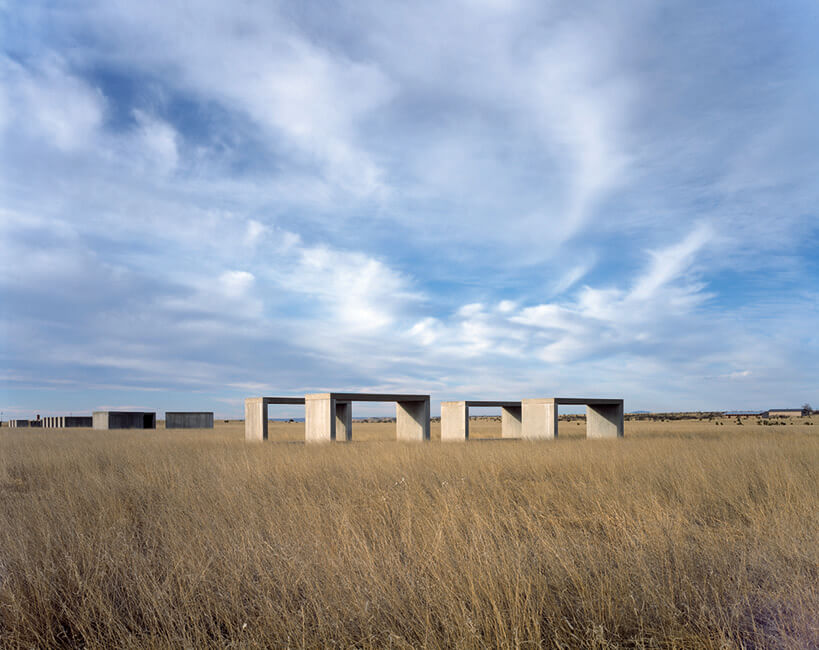
DONALD JUDD, 15 UNTITLED WORKS IN CONCRETE, 1980–1984. PERMANENT COLLECTION, THE CHINATI FOUNDATION, MARFA, TEXAS. COURTESY OF JUDD FOUNDATION. DONALD JUDD ART © JUDD FOUNDATION / ARTISTS RIGHTS SOCIETY (ARS), NEW YORK.
II. THE GRAMMAR, ABSORBED
The Marfa project is usually described through its objects. The hundred mill-aluminum boxes in the artillery sheds, the concrete units in the field, the installations at the Block. This is the tourist grammar of Judd, and it is not wrong, only incomplete. The harder question is what Judd was doing to architecture. His answer was radical and plain at once: build once, install once, and let nothing come into the room that does not belong there permanently.
Build once, install once, and let nothing come into the room that does not belong there permanently.
That instruction, absorbed and rewritten by forty years of residential architects who read it without always attributing it, is now close to invisible. It has become the grammar itself. Any house built in 2026 for a collector with disciplined taste, any room organized around full-height joinery and a single fireplace, any space where the furniture and the walls appear to have been drawn at the same moment, is reading from Judd. Most do not say so. Most could not say so. The citation has gone quiet because the source has been fully absorbed.
A useful test, then, is not who quotes Judd loudly, but who inherits the discipline and leaves the polemic behind. Judd fought the art market, wrote political essays, bought forty thousand acres of ranch land in protest of how work was sold and displaced. The heirs who matter are the ones who kept the rigor of the Block and dropped the argument. They build for living, not for manifesto.
III. BRIANZA

B RESIDENCE, BRIANZA, LOMBARDY. VINCENT VAN DUYSEN ARCHITECTS, 2023. PHOTO MARK SEELEN, COURTESY VINCENT VAN DUYSEN ARCHITECTS AND EST LIVING.
B Residence, completed in 2023 by the Antwerp studio of Vincent Van Duysen, sits among old trees in a wooded park north of Milan, in the Brianza region of Lombardy. It won the ELLE Decor Italia Best of Interiors Award 2024 in the villa category and appeared on the cover of ED Italia the same year. It is, in almost every line, a residential reading of the Block.

Van Duysen began with the land. The site slopes, and rather than arguing with the slope he raised the foundation above ground level and let the basement act as a plinth: a low masonry platform from which the house appears to rise. The walls, in his own description, are conceived as screens that begin directly at the ground. Windows line up in a single continuous band below the eaves, protected by wide roof overhangs. From outside, the house reads as horizontal bands stacked and stepped, black terracotta brick on the south facade, plastered brick on the north. The photograph is pure rectangles and a long line of glass. Placed next to a photograph of the east warehouse at the Block, the formal vocabulary is the same: mass, aperture, eave, permanence.

THE FIREPLACE IS THE ANCHOR OF THE COMPOSITION, SEPARATING SHARED AND PRIVATE SPACES WITHOUT A SINGLE PARTITION WALL.
Inside, the discipline goes further. There are no partition walls. The fireplace is the pivot around which the plan turns. Integrated storage divides the shared rooms from the private ones. Van Duysen writes of loose furniture drawn to become part of the building, a small project within the larger macrocosm, functional to the purpose of the house and integrating with the surroundings in material and form. This is precisely what Judd did in pine at the Block in the seventies, to his own less forgiving measurements. Solid blocks of natural wood carry between the rooms as connective tissue. Oak floors, glass, stone. The fireplace anchors. Everything that can be built in is built in.

What has changed, from Marfa to Brianza, is the register. Judd’s rooms are precise, but they are instruction. Van Duysen has taken the instruction and translated it into the warmer grammar of the residential collector, the same refusal to add what does not belong, the same governing proportion, but a floor you can walk barefoot on and a sofa you can fall asleep in. A Noguchi Akari softens a corner. A Maxalto armchair sits near the hearth. The canonical Italian furniture does not compete with the architecture, it completes it, in the same way Judd’s pine furniture completed the east warehouse.
Nothing in B Residence announces its lineage. Van Duysen never mentions Judd in the project text. He does not need to. The reader who has stood inside the Block recognizes the instruction the moment the photograph loads.
CODA
The quiet citation is the most durable. Between the warehouses of Fort D.A. Russell and the villa among the ancient trees of Brianza, across forty years and an ocean, the instruction is the same. Build once, for good, with nothing that can be removed. Let the room do the talking.
FURTHER READING
Donald Judd Spaces, edited by Flavin Judd and Caitlin Murray. Judd Foundation and The Monacelli Press, 2020. The first comprehensive record of Judd’s permanently installed spaces at 101 Spring Street, the Block, the downtown studios, and the ranch.
Vincent Van Duysen: Private. Thames & Hudson, 2024. A monograph on Van Duysen’s recent residential work, including B Residence in Brianza, Casa M, and DH Apartment.
Sources: Chinati Foundation; Judd Foundation (La Mansana de Chinati local history, 15 untitled works in concrete); Vincent Van Duysen Architects; ELLE Decor Italia, Best of Interiors Award 2024; est living, B Residence home tour, photography by Mark Seelen.
— The Home&Decor Editors